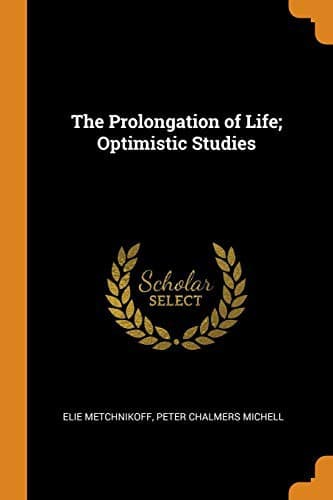
The Prolongation of Life: Optimistic StudiesMetchnikoff, Elie
Science
The Prolongation of Life: Optimistic Studies
Metchnikoff, Elie
Aging; Hygiene; Longevity; Older people -- Social conditions
Although the intestinal wall in an intact state offers a substantial
obstacle to the passage of bacteria, it is incontestable that some
of these pass through it into the organs and the blood. Numerous
experiments performed on different kinds of animals (horses, dogs,
rabbits, etc.) show that some of the microbes taken with food traverse
the wall of the alimentary canal and come to occupy the adjacent
lymphatic glands, the lungs, the spleen and the liver, whilst they
are occasionally found in the blood and lymph. Discussion has taken
place as to whether the passage takes place when the wall of the gut
is absolutely intact or only when it is injured to however small
an extent. It would be extremely difficult to settle the question
definitely, but it is easy to see that it has little practical bearing.
It is known that the wall of the gut is damaged extremely easily, so
that the bluntest sound can hardly be passed into the stomach without
making a wound through which microbes can pass into the tissues and
blood. In the ordinary course of life, the delicate wall of the gut
must often undergo slight wounding, and the frequent presence of
microbes in the mesenteric ganglia of healthy animals shows clearly
what takes place.[56]
It is indubitable, therefore, that the intestinal microbes or their
poisons may reach the system generally and bring harm to it. I infer
from the facts that the more a digestive tract is charged with
microbes, the more it is a source of harm capable of shortening life.
As the large intestine not only is the part of the digestive tube most
richly charged with microbes, but is relatively more capacious in
mammals than in any other vertebrates, it is a just inference that the
duration of life of mammals has been notably shortened as the result of
chronic poisoning from an abundant intestinal flora.
IV
MICROBES AS THE CAUSE OF SENILITY
Relations between longevity and the intestinal
flora—Ruminants—The Horse—Intestinal flora of
birds—Intestinal flora of cursorial birds—Duration
of life in cursorial birds—Flying mammals—Intestinal
flora and longevity of bats—Some exceptions to the
rule—Resistance of the lower vertebrates to certain
intestinal microbes
In the actual state of our knowledge it is impossible to make a final
examination of my hypothesis, as there are many factors about which we
are incompletely informed. Nevertheless, it is possible to confront the
hypothesis with a large number of accurately established facts.
Public-domain text, read in full here on John Shaqi.
Reviews
Reviews
No reviews yet
Be the first to share your thoughts on this work.
Elsewhere in the archive
Join the Discussion
Join the discussion
Sign in to leave a comment or review.
Sign InorCreate an account