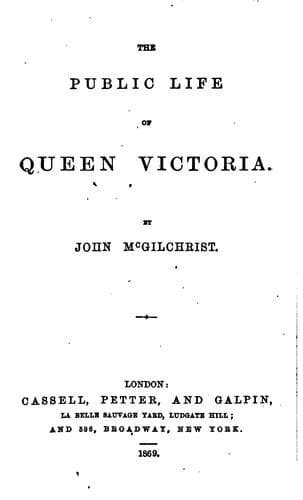
The Public Life of Queen VictoriaMcGilchrist, John
History
The Public Life of Queen Victoria
McGilchrist, John
Victoria, Queen of Great Britain, 1819-1901
The first message which the Queen sent to Parliament when it re-assembled,
was a truly characteristic one: it asked for a suitable provision for her
royal mother. This provision was loyally made, and in the same short
winter session her own civil list was settled. William IV. had enjoyed a
civil list amounting to L510,000, while, from the accession of George III.
to the death of his eldest son, it had been fixed at L1,030,000. Her
Majesty's civil list was fixed at L385,000 per annum, and her privy purse,
being the only sum over which she had complete personal control, and from
which her private charities had to be disbursed, was fixed at L60,000. Out
of the L385,000 the calculation, based by order of Parliament upon the
accounts of the late reign, was that L131,260 would go for salaries of the
Household, from the Master of the Horse and Mistress of the Robes, down to
the humblest scullion and stable-helper; and L172,500 in tradesmen's
bills.
During the early days of her maiden reign, the Queen rose at eight,
occupied a remarkably short time in dressing, and then discharged such
routine business as signing despatches until the breakfast hour, which was
invariably a quarter before ten. At that hour, she without fail sent one
of her attendants to _invite_ the Duchess of Kent to breakfast. From the
day of her ascending the throne, to remove the slightest ground for
suspicion as to any undue influence, the strictest etiquette was preserved
between mother and daughter; the former never approaching the latter
unless specially summoned, and carefully abstaining from conversing about
the business of the State. Twelve o'clock was the time appointed for
conferences with her Ministers. After the usual complimentary salutation,
she at once proceeded to the business of the day. If a document were
handed to her, she read it without comment, and no remark passed her own
lips or those of the Ministers present, until its perusal was concluded.
After retiring from the Council-room, the interval was passed until dinner
in riding or walking. At dinner, the first Lord-in-waiting took the head
of the table; opposite to him, the chief Equerry-in-waiting. Her Majesty's
chair was half way down on the right, the various guests being seated
according to their ranks. Next to Her Majesty, on the right hand, was the
nobleman of highest degree; next to him, the Duchess of Kent, and so on.
On Her Majesty's left, the same rule was observed, the Baroness Lehzen,
who acted as Secretary to the Queen, being always near her. The Queen left
the table early for the drawing-room, where her musical tastes were
regaled almost invariably, and her own proficiency very frequently
displayed.
[Sidenote: REVERENCE FOR SUNDAY.]
Public-domain text, read in full here on John Shaqi.
Reviews
Reviews
No reviews yet
Be the first to share your thoughts on this work.
Elsewhere in the archive
Join the Discussion
Join the discussion
Sign in to leave a comment or review.
Sign InorCreate an account