This was a story of the Tunisian sands, written, she decided, by one
who hadn’t been there; one who saw the desert as the average American
reader would expect, but with additional flatfooted bits of color
tramped down with audacity. Moonlight was different in Tunisia, and
morals were different--freer than here. There was the glitter of the
snake’s eye through the pages, for Pidge Musser. It made her think of a
sick man in a gorgeous robe.
She had inferred from Melton’s talk that this story was new; in
fact, that it was still hot from his machine. Yet the manuscript
didn’t feel new; the front and back pages showed wear. Could she
have misunderstood?... It had freedom; not the freedom of ignorance,
but the freedom of a drifting ship. Its anchor dragged, its compass
was uncentered. It cried out, “My God, I am free!” and it was, as a
derelict is free.
At a quarter of ten, she heard the bell in the basement hall; heard
Miss Claes directing Melton to the next floor. Pidge would not have
had it this way, but people of the house were in the basement. He came
up out of the dim stairway, walking wide, his soft cap crumpled in his
hand, elbows out. He must have learned her name from Miss Claes.
“You mustn’t think, Miss Musser, that I don’t know how much I am
asking--this favor of yours to-night.”
There was a sort of lift and draw to the way he took her hand; at the
same time his shoulders and head bent down upon her. This thing that
he was playing to-night was college boy--clumsy subtlety of a big boy
coming home and greeting his sister--seeing in her, at the moment of
greeting, something of the charm other boys might see. He walked around
her under the light, laughing, apologizing, making a humorous picture
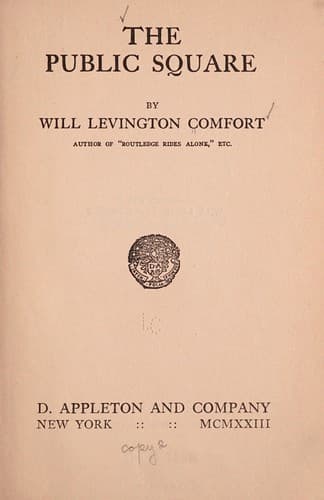
of his own tension at _The Public Square_ that afternoon.
“I went there like an anarchist,” he laughed. “I was prepared to get my
answer or blow up the place. I had to laugh afterwards the way I seized
upon you.”
“I read the Tunis story,” she said. “Of course, you know it’s really
unimportant what I think. I liked it well enough, but wasn’t carried
away. I felt the color; in fact, color is the main asset of the story,
but it seemed a bit thick----”
He laughed aloud. He was bending to her again, and most benignly,
college big brother still in his manner and voice.
“I could tone that down, of course. The trouble is to get a thing like
that straight, when you know that part of Africa as I do. I ought to
have kept off Tunis, that’s the truth of it.”
“You have really been there?”
“That’s the worst of it, Miss Musser,” he laughed. “I went through hell
for that story. Too much feeling to write with, you understand.”
Pidge was awed at her own error. She had been so convinced that the
color was faked that she had judged the whole story on that basis.
Public-domain text, read in full here on John Shaqi.
Reviews
Reviews
No reviews yet
Be the first to share your thoughts on this work.
Join the Discussion
Join the discussion
Sign in to leave a comment or review.
Sign InorCreate an account