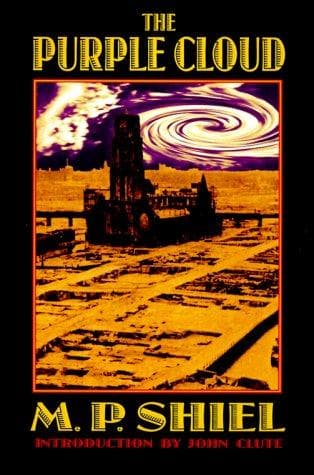
Apocalyptic fantasies; End of the world -- Fiction; Natural disasters -- Fiction; Science fiction
Well, the next morning I went down the steep High Street, and found a
young nun at the bottom whom I had left the previous evening with a
number of girls in uniform opposite the Guildhall--half-way up the
street. She must have been spun down, arm over arm, for the wind was
westerly, and whereas I had left her completely dressed to her wimple
and beads, she was now nearly stripped, and her little flock scattered.
And branches of trees, and wrecked houses, and reeling clouds of dead
leaves were everywhere that wild morning.
This town of Guildford appeared to be the junction of an extraordinary
number of railway-lines, and before again setting out in the afternoon,
when the wind had lulled, having got an A B C guide, and a railway-map,
I decided upon my line, and upon a new engine, feeling pretty sure now
of making London, only thirty miles away. I then set out, and about five
o'clock was at Surbiton, near my aim; I kept on, expecting every few
minutes to see the great city, till darkness fell, and still, at
considerable risk, I went, as I thought, forward: but no London was
there. I had, in fact, been on a loop-line, and at Surbiton gone wrong
again; for the next evening I found myself at Wokingham, farther away
than ever.
I slept on a rug in the passage of an inn called The Rose, for there was
a wild, Russian-looking man, with projecting top-teeth, on a bed in the
house, whose appearance I did not like, and it was late, and I too tired
to walk further; and the next morning pretty early I set out again, and
at 10 A.M. was at Reading.
The notion of navigating the land by precisely the same means as the
sea, simple and natural as it was, had not at all occurred to me: but at
the first accidental sight of a compass in a little shop-window near the
river at Reading, my difficulties as to getting to any desired place in
the world vanished once and for all: for a good chart or map, the
compass, a pair of compasses, and, in the case of longer distances, a
quadrant, sextant or theodolite, with a piece of paper and pencil, were
all that were necessary to turn an engine into a land-ship, one choosing
the lines that ran nearest the direction of one's course, whenever they
did not run precisely.
Public-domain text, read in full here on John Shaqi.
Reviews
Reviews
No reviews yet
Be the first to share your thoughts on this work.
Join the Discussion
Join the discussion
Sign in to leave a comment or review.
Sign InorCreate an account