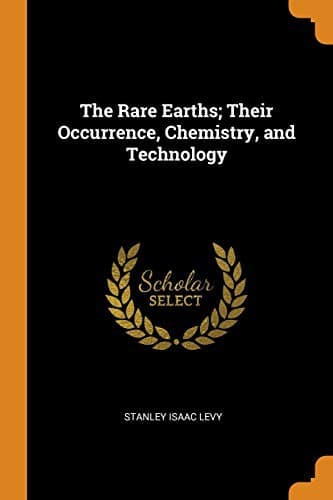
The Rare Earths: Their Occurrence, Chemistry, and TechnologyLevy, Stanley Isaac
Science
The Rare Earths: Their Occurrence, Chemistry, and Technology
Levy, Stanley Isaac
Rare earths
Thorianite occurs in jet-black crystals with a bright resinous lustre.
They are pseudocubic, and the twinning resembles that of the cubic
mineral fluorspar--interpenetrant cubes, twin axis a cube diagonal.
Close examination shows, however, that twinning can only take place
about one of the four diagonals, and an optical examination makes it
clear that the symmetry is really rhombohedral. The case is exactly
analogous to that of the mineral chabazite, a zeolite which occurs in
rhombohedra of which the angles differ but little from those of the
cube, and which also forms the interpenetrant twins. In view of the
fact that both uranous oxide and thoria have been obtained as
octahedra, whilst a fused mixture of the two on cooling forms cubic
crystals, it seems not unlikely that at high temperatures the
pseudocubic thorianite would become truly cubic; but no experiments in
this direction seem to have been tried.
The crystals are brittle; hardness 7; sp. gr. 8·0-9·7.
Thorianite is infusible, incandescing before the blowpipe. When
powdered, it dissolves readily in nitric and sulphuric acids, with
evolution of helium. Gray[89] has shown that the helium content can be
reduced by 28 per cent. by fine grinding, thus showing that part at
least of the gas must be mechanically held.
[89] _Proc. Roy. Soc._ 1908, A, ~82~, 306.
Thorianite was found in Ceylon, being originally mistaken for
pitchblende. A sample was supplied by the discoverer, Mr. Holland, to
the officers of the Mineral Survey, by whom it was sent to London for
examination. Its composition was determined by Dunstan, who named it. It
was found in the river gravels (gem-gravels), the matrix being a
pegmatite granite. It is a valuable source of thorium nitrate for
incandescent mantles, one ton of the mineral (with thoria content of 70
per cent.) having been sold for £1500; but the supply is small and
unreliable.
~Baddeleyite.~[90]-- Baddeleyite consists of almost pure zirconia (ZrO₂
= 96·5 per cent.) with small quantities of ferric oxide, alumina, lime,
magnesia, alkalies and silica. Thoria and rare earths are present in
traces, uranium is absent; the mineral is not radioactive, and contains
only traces of helium.
[90] _Vide_ Fletcher, _Min. Mag._ 1893, 46, ~10~, 148; Hussak,
_Zeitsch. Kryst. Min._ 1895, ~24~, 164, and ~25~, 298.
Monoclinic--_a_ : _b_ : _c_ = 0·9871 : 1 : 0·5114. β = 98° 45¹⁄₂´.
Common forms--all three pinakoids, _a_ {100}, _b_ {010}, and _c_
{001}, with the hemi-prisms _m_ {110}, _k_ {120}, and _l_ {230}, and
various pyramids and domes.
Angles--(100) ∧ (110) = 44° 17¹⁄₂´; (100) ∧ (001) = 81° 14¹⁄₂´; (100)
∧ (101) = 55° 33¹⁄₂´.
Cleavage ∥ _c_ and ∥ _b_, parting ∥ _m_ due to repeated twinning.
Twinning is exceedingly common; of many hundred crystals examined by
Hussak, only three were found untwinned. Twin planes _m_ (110), _a_
(100), and _x_ (201).
Public-domain text, read in full here on John Shaqi.
Reviews
Reviews
No reviews yet
Be the first to share your thoughts on this work.
Join the Discussion
Join the discussion
Sign in to leave a comment or review.
Sign InorCreate an account