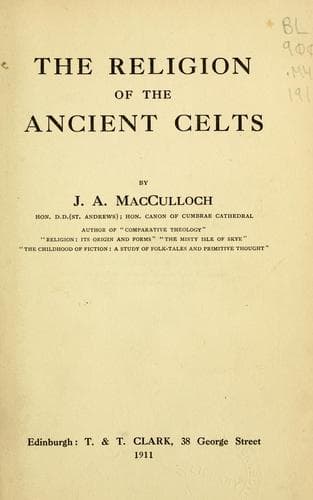
The Religion of the Ancient CeltsMacCulloch, J. A. (John Arnott)
Religion
The Religion of the Ancient Celts
MacCulloch, J. A. (John Arnott)
Celts -- Religion; Mythology, Celtic
Tethra, with Balor and Elatha, ruled over Erin at the coming of the
Tuatha Dé Danann. From a phrase used in the story of Connla's visit to
Elysium, "Thou art a hero of the men of Tethra," M. D'Arbois assumes
that Tethra was ruler of Elysium, which he makes one with the land of
the dead. The passage, however, bears a different interpretation, and
though a Fomorian, Tethra, a god of war, might be regarded as lord of
all warriors.[192] Elysium was not the land of the dead, and when M.
D'Arbois equates Tethra with Kronos, who after his defeat became ruler
of a land of dead heroes, the analogy, like other analogies with Greek
mythology, is misleading. He also equates Bres, as temporary king of the
Tuatha Dé Danann, with Kronos, king of heaven in the age of gold.
Kronos, again, slain by Zeus, is parallel to Balor slain by his grandson
Lug. Tethra, Bres, and Balor are thus separate fragments of one god
equivalent to Kronos.[193] Yet their personalities are quite distinct.
Each race works out its mythology for itself, and, while parallels are
inevitable, we should not allow these to override the actual myths as
they have come down to us.
Professor Rh[^y]s makes Bile, ancestor of the Milesians who came from
Spain, a Goidelic counterpart of the Gaulish Dispater, lord of the dead,
from whom the Gauls claimed descent. But Bile, neither a Fomorian nor of
the Tuatha Dé Danann, is an imaginary and shadowy creation. Bile is next
equated with a Brythonic Beli, assumed to be consort of Dôn, whose
family are equivalent to the Tuatha Dé Danann.[194] Beli was a mythic
king whose reign was a kind of golden age, and if he was father of Dôn's
children, which is doubtful, Bile would then be father of the Tuatha Dé
Danann. But he is ancestor of the Milesians, their opponents according
to the annalists. Beli is also equated with Elatha, and since Dôn,
reputed consort of Beli, was grandmother of Llew, equated with Irish
Lug, grandson of Balor, Balor is equivalent to Beli, whose name is
regarded by Professor Rh[^y]s as related etymologically to Balor's.[195]
Bile, Balor, and Elatha are thus Goidelic equivalents of the shadowy
Beli. But they also are quite distinct personalities, nor are they ever
hinted at as ancestral gods of the Celts, or gods of a gloomy
underworld. In Celtic belief the underworld was probably a fertile
region and a place of light, nor were its gods harmful and evil, as
Balor was.
Public-domain text, read in full here on John Shaqi.
Reviews
Reviews
No reviews yet
Be the first to share your thoughts on this work.
Join the Discussion
Join the discussion
Sign in to leave a comment or review.
Sign InorCreate an account