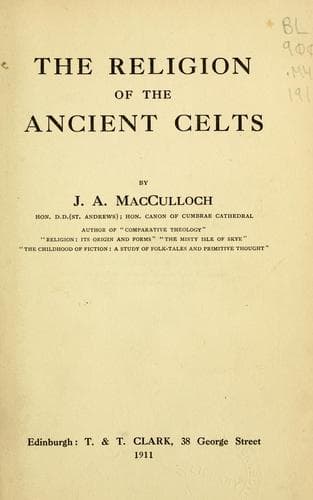
The Religion of the Ancient CeltsMacCulloch, J. A. (John Arnott)
Religion
The Religion of the Ancient Celts
MacCulloch, J. A. (John Arnott)
Celts -- Religion; Mythology, Celtic
On the whole, the Fomorians came to be regarded as the powers of nature
in its hostile aspect. They personified blight, winter, darkness, and
death, before which men trembled, yet were not wholly cast down, since
the immortal gods of growth and light, rulers of the bright other-world,
were on their side and fought against their enemies. Year by year the
gods suffered deadly harm, but returned as conquerors to renew the
struggle once more. Myth spoke of this as having happened once for all,
but it went on continuously.[196] Gods were immortal and only seemed to
die. The strife was represented in ritual, since men believe that they
can aid the gods by magic, rite, or prayer. Why, then, do hostile
Fomorians and Tuatha Dé Danann intermarry? This happens in all
mythologies, and it probably reflects, in the divine sphere, what takes
place among men. Hostile peoples carry off each the other's women, or
they have periods of friendliness and consequent intermarriage. Man
makes his gods in his own image, and the problem is best explained by
facts like these, exaggerated no doubt by the Irish annalists.
The Tuatha Dé Danann, in spite of their euhemerisation, are more than
human. In the north where they learned magic, they dwelt in four cities,
from each of which they brought a magical treasure--the stone of Fal,
which "roared under every king," Lug's unconquerable spear, Nuada's
irresistible sword, the Dagda's inexhaustible cauldron. But they are
more than wizards or Druids. They are re-born as mortals; they have a
divine world of their own, they interfere in and influence human
affairs. The euhemerists did not go far enough, and more than once their
divinity is practically acknowledged. When the Fian Caoilte and a woman
of the Tuatha Dé Danann appear before S. Patrick, he asks, "Why is she
youthful and beautiful, while you are old and wrinkled?" And Caoilte
replies, "She is of the Tuatha Dé Danann, who are unfading and whose
duration is perennial. I am of the sons of Milesius, that are perishable
and fade away."[197]
After their conversion, the Celts, sons of Milesius, thought that the
gods still existed in the hollow hills, their former dwellings and
sanctuaries, or in far-off islands, still caring for their former
worshippers. This tradition had its place with that which made them a
race of men conquered by the Milesians--the victory of Christianity over
paganism and its gods having been transmuted into a strife of races by
the euhemerists. The new faith, not the people, conquered the old gods.
The Tuatha Dé Danann became the _Daoine-sidhe_, a fairy folk, still
occasionally called by their old name, just as individual fairy kings or
queens bear the names of the ancient gods. The euhemerists gave the
Fomorians a monstrous and demoniac character, which they did not always
give to the Tuatha Dé Danann; in this continuing the old tradition that
Fomorians were hostile and the Tuatha Dé Danann beneficent and mild.
Public-domain text, read in full here on John Shaqi.
Reviews
Reviews
No reviews yet
Be the first to share your thoughts on this work.
Join the Discussion
Join the discussion
Sign in to leave a comment or review.
Sign InorCreate an account