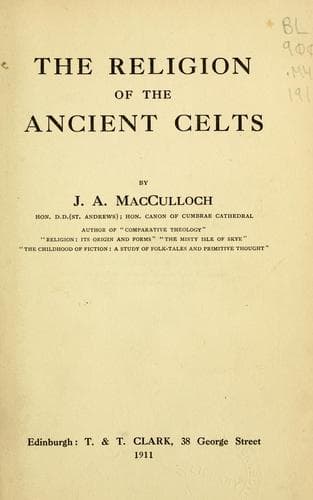
The Religion of the Ancient CeltsMacCulloch, J. A. (John Arnott)
Religion
The Religion of the Ancient Celts
MacCulloch, J. A. (John Arnott)
Celts -- Religion; Mythology, Celtic
Although the Irish gods are warriors, and there are special war-gods,
yet war-goddesses are more prominent, usually as a group of
three--Morrigan, Neman, and Macha. A fourth, Badb, sometimes takes the
place of one of these, or is identical with Morrigan, or her name, like
that of Morrigan, may be generic.[235] _Badb_ means "a scald-crow,"
under which form the war-goddesses appeared, probably because these
birds were seen near the slain. She is also called Badbcatha,
"battle-Badb," and is thus the equivalent of _-athubodua,_ or, more
probably, _Cathubodua_, mentioned in an inscription from Haute-Savoie,
while this, as well as personal names like _Boduogenos_, shows that a
goddess Bodua was known to the Gauls.[236] The _badb_ or battle-crow is
associated with the Fomorian Tethra, but Badb herself is consort of a
war-god Nét, one of the Tuatha Dé Danann, who may be the equivalent of
Neton, mentioned in Spanish inscriptions and equated with Mars.
Elsewhere Neman is Nét's consort, and she may be the Nemetona of
inscriptions, e.g. at Bath, the consort of Mars. Cormac calls Nét and
Neman "a venomous couple," which we may well believe them to have
been.[237] To Macha were devoted the heads of slain enemies, "Macha's
mast," but she, according to the annalists, was slain at Mag-tured,
though she reappears in the Cúchulainn saga as the Macha whose
ill-treatment led to the "debility" of the Ulstermen.[238] The name
Morrigan may mean "great queen," though Dr. Stokes, connecting _mor_
with the same syllable in "Fomorian," explains it as
"nightmare-queen."[239] She works great harm to the Fomorians at
Mag-tured, and afterwards proclaims the victory to the hills, rivers,
and fairy-hosts, uttering also a prophecy of the evils to come at the
end of time.[240] She reappears prominently in the Cúchulainn saga,
hostile to the hero because he rejects her love, yet aiding the hosts of
Ulster and the Brown Bull, and in the end trying to prevent the hero's
death.[241]
Public-domain text, read in full here on John Shaqi.
Reviews
Reviews
No reviews yet
Be the first to share your thoughts on this work.
Elsewhere in the archive
Join the Discussion
Join the discussion
Sign in to leave a comment or review.
Sign InorCreate an account