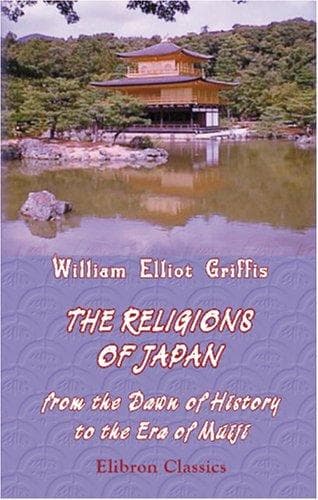
The Religions of Japan, from the Dawn of History to the Era of MéijiGriffis, William Elliot
Religion
The Religions of Japan, from the Dawn of History to the Era of Méiji
Griffis, William Elliot
Japan -- Religion
To the common people the sun is actually a god, as none can doubt who
sees them worshipping it morning and evening. The writer can never
forget one of many similar scenes in Tōkiō, when late one
afternoon after O Tentō Sama (the sun-Lord of Heaven), which had been
hidden behind clouds for a fortnight, shone out on the muddy streets. In
a moment, as with the promptness of a military drill, scores of people
rushed out of their houses and with faces westward, kneeling, squatting,
began prayer and worship before the great luminary. Besides all the
gods, supreme, subordinate and local, there is in nearly every house the
Kami-dana or god-shelf. This is usually over the door inside. It
contains images with little paper-covered wooden tablets having the
god's name on them. Offerings are made by day and a little lamp is
lighted at night. The following is one of several prayers which are
addressed to this kami-dana.
Reverently adoring the great god of the two palaces of Isé, in
the first place, the eight hundred myriads of celestial gods,
the eight hundred myriads of terrestrial gods, all the fifteen
hundred myriads of gods to whom are consecrated the great and
small temples in all provinces, all islands and all places of
the Great Land of Eight Islands, the fifteen hundreds of myriads
of gods whom they cause to serve them, and the gods of branch
palaces and branch temples, and Sohodo no kami, whom I have
invited to the shrine set up on this divine shelf, and to whom I
offer praises day by day, I pray with awe that they will deign
to correct the unwitting faults, which, heard and seen by them,
I have committed, and blessing and favoring me according to the
powers which they severally wield, cause me to follow the divine
example, and to perform good works in the Way.
Shintō Left in a State of Arrested Development.
Thus from the emperor to the humblest believer, the god-way is founded
on ancestor worship, and has had grafted upon its ritual system nature
worship, even to phallicism.[29] In one sense it is a self-made religion
of the Japanese. Its leading characteristics are seen in the traits of
the normal Japanese character of to-day. Its power for good and evil may
be traced in the education of the Japanese through many centuries.
Knowing Shintō, we to a large degree know the Japanese, their virtues
and their failings.
Public-domain text, read in full here on John Shaqi.
Reviews
Reviews
No reviews yet
Be the first to share your thoughts on this work.
Join the Discussion
Join the discussion
Sign in to leave a comment or review.
Sign InorCreate an account