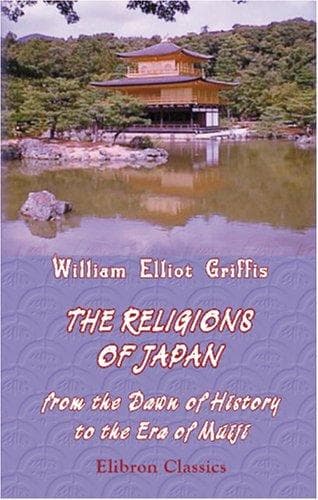
The Religions of Japan, from the Dawn of History to the Era of MéijiGriffis, William Elliot
Religion
The Religions of Japan, from the Dawn of History to the Era of Méiji
Griffis, William Elliot
Japan -- Religion
What Shintō might have become in its full evolution had it been left
alone, we cannot tell. Whether in the growth of the nation and without
the pressure of Buddhism, Confucianism or other powerful influences from
outside, the scattered and fragmentary mythology might have become
organized into a harmonious system, or codes of ethics have been
formulated, or the doctrines of a future life and the idea of a Supreme
Being with personal attributes have been conceived and perfected, are
questions the discussion of which may seem to be vain. History, however,
gives no uncertain answer as to what actually did take place. We do but
state what is unchallenged fact, when we say, that after commitment to
writing of the myths, poems and liturgies which may be called the basis
of Shintō, there came a great flood of Chinese and Buddhistic
literature and a tremendous expansion of Buddhist missionary activity,
which checked further literary growth of the kami system. These prepared
the way for the absorption of the indigenous into the foreign cultus
under the form called by an enthusiastic emperor, Riyōbu Shintō,
or the "two-fold divine doctrine." Of this, we shall speak in another
lecture.
Suffice it here to say that by the scheme of syncretism propounded by
Kōbō in the ninth century, Shintō was practically overlaid by
the new faith from India, and largely forgotten as a distinct religion
by the Japanese people. As late as A.D. 927, there were three thousand
one hundred and thirty-two enumerated metropolitan and provincial
temples, besides many more unenumerated village and hamlet shrines of
Shintō. These are referred to in the revised codes of ceremonial law
set forth by imperial authority early in the tenth century. Probably by
the twelfth century the pure rites of the god-way were celebrated, and
the unmixed traditions maintained, in families and temples, so few as to
be counted on the fingers. The ancient language in which the archaic
forms had been preserved was so nearly lost and buried, that out of the
ooze of centuries of oblivion, it had to be rescued by the skilled
divers of the seventeenth century. Mabuchi, Motöri and the other
revivalists of pure Shintō, like the plungers after orient pearls,
persevered until they had first recovered much that had been supposed
irretrievably lost. These scholars deciphered and interpreted the
ancient scriptures, poetry, prose, history, law and ritual, and once
more set forth the ancient faith, as they believed, in its purity.
Public-domain text, read in full here on John Shaqi.
Reviews
Reviews
No reviews yet
Be the first to share your thoughts on this work.
Join the Discussion
Join the discussion
Sign in to leave a comment or review.
Sign InorCreate an account