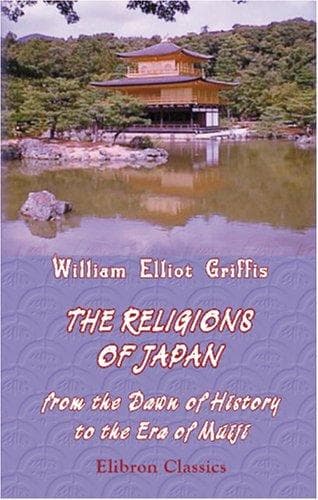
The Religions of Japan, from the Dawn of History to the Era of MéijiGriffis, William Elliot
Religion
The Religions of Japan, from the Dawn of History to the Era of Méiji
Griffis, William Elliot
Japan -- Religion
His own table-talk, conversations, discussions and notes were compiled
by his pupils, and are preserved in the work entitled in English, "The
Confucian Analects," which is one of the four books constituting the
most sacred portion of Chinese philosophy and instruction. He also wrote
a work named "Spring and Autumn, or Chronicles of his Native State of Lu
from 722 B.C., to 481[4] B.C." He "changed his world," as the Buddhists
say, in the year 478 B.C., having lived seventy-three years.
Primitive Chinese Faith.
The pre-Confucian or primitive faith was monotheistic, the forefathers
of the Chinese nation having been believers in one Supreme Spiritual
Being. There is an almost universal agreement among scholars in
translating the term "Shang Ti" as God, and in reading from these
classics that the forefathers "in the ceremonies at the altars of Heaven
and earth ... served God." Concurrently with the worship of one Supreme
God there was also a belief in subordinate spirits and in the idea of
revelation or the communication of God with men. This restricted worship
of God was accompanied by reverence for ancestors and the honoring of
spirits by prayers and sacrifices, which resulted, however, neither in
deification nor polytheism. But, as the European mediæval schoolmen have
done with the Bible, so, after the death of Confucius the Chinese
scholastics by metaphysical reasoning and commentary, created systems of
interpretation which greatly altered the apparent form and contents of
his own and of the ancient texts. Thus, the original monotheism of the
pre-Confucian documents has been completely obscured by the later webs
of sophistry which have been woven about the original scriptures. The
ancient simplicity of doctrine has been lost in the mountains of
commentary which were piled upon the primitive texts. Throughout the
centuries, the Confucian system has been conditioned and greatly
modified by Taoism, Buddhism and the speculations of the Chinese wise
men.
Confucius, however, did not change or seriously modify the ancient
religion except that, as is more than probable, he may have laid
unnecessary emphasis upon social and political duties, and may not have
been sufficiently interested in the honor to be paid to Shang Ti or God.
He practically ignored the God-ward side of man's duties. His teachings
relate chiefly to duties between man and man, to propriety and
etiquette, and to ceremony and usage. He said that "To give one's self
to the duties due to men and while respecting spiritual beings to keep
aloof from them, may be called wisdom."[5]
Public-domain text, read in full here on John Shaqi.
Reviews
Reviews
No reviews yet
Be the first to share your thoughts on this work.
Elsewhere in the archive
Join the Discussion
Join the discussion
Sign in to leave a comment or review.
Sign InorCreate an account