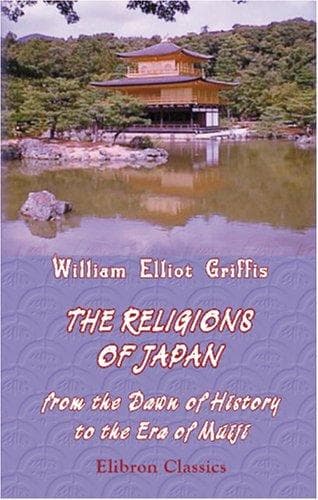
The Religions of Japan, from the Dawn of History to the Era of MéijiGriffis, William Elliot
Religion
The Religions of Japan, from the Dawn of History to the Era of Méiji
Griffis, William Elliot
Japan -- Religion
First. Although each of the Chinese and Japanese emperors is supposed to
be, and is called, "father of the people," yet it would be entirely
wrong to imagine that the phrase implies any such relation, as that of
William the Silent to the Dutch, or of Washington to the American
nation. In order to see how far the emperor was removed from the people
during a thousand years, one needs but to look upon a brilliant painting
of the Yamato-Tosa school, in which the Mikado is represented as sitting
behind a cloud of gold or a thick curtain of fine bamboo, with no one
before the matting-throne but his prime ministers or the empress and his
concubines. For centuries, it was supposed that the Mikado did not touch
the ground with his feet. He went abroad in a curtained car; and he was
not only as mysterious and invisible to the public eye as a dragon, but
he was called such. The attributes of that monster with many powers and
functions, were applied to him, with an amazing wealth of rhetoric and
vocabulary. As well might the common folks to-day presume to pray unto
one of the transcendent Buddhas, between whom and the needy suppliant
there may be hosts upon hosts of interlopers or mediators, as for an
ordinary subject to petition the emperor or even to gaze upon his dragon
countenance. The change in the constitutional Japan of our day is seen
in the fact that the term "Mikado" is now obsolete. This description of
the relation of sovereign and minister (inaccurately characterised by
some writers on Confucianism as that of "King and subject," a phrase
which might almost fit the constitutional monarchy of to-day) shows the
relation, as it did exist for nearly a thousand years of Japanese
history. We find the same imitation of procedure, even when imperialism
became only a shadow in the government and the great Shōgun who
called himself "Tycoon," the ruler in Yedo, aping the majesty of
Kiōto, became so powerful as to be also a dragon. Between the Yedo
Shōgun and the people rose a great staircase of numberless
subordinates, and should a subject attempt to offer a petition in person
he must pay for it by crucifixion.[12]
As, under the emperor there were court ministers, heads of departments,
governors and functionaries of all kinds before the people were reached,
so, under the Shōgun in the feudal days, there were the Daimiōs or
great lords and the Shomiōs or small lords with their retainers in
graduated subordination, and below these were the servants and general
humanity. Even after the status of man was reached, there were
gradations and degradations through fractions down to ciphers and indeed
to minus quantities, for there existed in the Country of Brave Warriors
some tens of thousands of human beings bearing the names of _eta_
(pariah) and _hī-nin_ (non-human), who were far below the pale of
humanity.
The Paramount Idea of Loyalty.
Public-domain text, read in full here on John Shaqi.
Reviews
Reviews
No reviews yet
Be the first to share your thoughts on this work.
Elsewhere in the archive
Join the Discussion
Join the discussion
Sign in to leave a comment or review.
Sign InorCreate an account