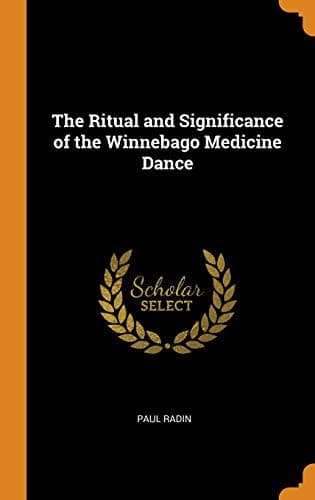
The ritual and significance of the Winnebago medicine danceRadin, Paul
Religion
The ritual and significance of the Winnebago medicine dance
Radin, Paul
Thesis (Ph. D.); Winnebago Indians -- Rites and ceremonies
It would be quite erroneous to imagine that the prayer for long life,
passage to the next world, and transmigration, are ideas specifically
connected with the Medicine Dance. As a matter of fact, they constitute
the characteristic cultural traits of the Winnebago, and crop out
everywhere in the folk-lore and in the general rituals. The question of
the safe passage to the next world is perhaps even more specifically
associated with the Four Nights’ Wake. The purpose of the wake is to
enable the deceased to successfully overcome the four great obstacles
on the road to the spirit home of his clan. This is accomplished,
first, by the performance of a definite ritual; and, secondly, by some
warrior relating one of his exploits on the warpath and putting at
the disposal of the deceased the spirit of the man he had killed, to
act as a servant to him. The close relation between the ethical worth
of the deceased and of the one who relates the exploit, on the one
hand, and the safe journey to the spirit world, on the other, comes
out as strongly here as it does in the Medicine Dance; but it seems
unnecessary, for that reason, to predicate any historical connection
between the two. They both reflect the cultural background around them.
Similarly the various elements that make up the life which the
members of the Medicine Dance pray for,—the food-supply, the power of
healing, success on the warpath, a normal quota of years,—these are
all definitely associated with spirits and ceremonials. Success in war
is associated, not with one society, but with a number of societies.
It would, however, be manifestly erroneous and unnecessary to claim
that it belongs essentially more to the one than to the other society,
unless direct historical proof for such a statement were forthcoming.
6. _Summary._—We are now in a better position to see in what the nature
of the complete ceremonial complex consists. The unit it consists of
is loose in the Ojibwa-Menominee, and strong in the Shell and Pebble
Societies and in the Medicine Dance. The specific component elements
are to a large extent different in each. It is utterly impossible now
to discover the origin of the differences in the individual component
elements; but it is quite clear that the forces tending to develop the
larger ceremonial complexes have been, not those of a dissociation, but
distinctly those of an association, of elements.
These associations may be of the most diverse kind. Certain features
may always have been associated with certain other elements, such as
medicinal herbs and medicines with the water-spirit, as in the case of
the Omaha and Winnebago. This, then, is for all practical purposes an
ultimate unit. If, consequently, we find an intimate connection between
a vision from the water-spirit and the practice of medicinal herbs, we
must not consider this as a secondary association that has come about
through the influence of a ceremony.
Public-domain text, read in full here on John Shaqi.
Reviews
Reviews
No reviews yet
Be the first to share your thoughts on this work.
Join the Discussion
Join the discussion
Sign in to leave a comment or review.
Sign InorCreate an account