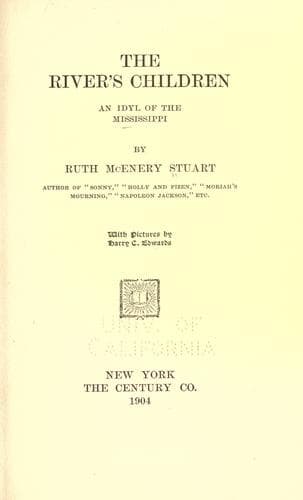
The River's Children: An Idyl of the MississippiStuart, Ruth McEnery
General
The River's Children: An Idyl of the Mississippi
Stuart, Ruth McEnery
African Americans -- Fiction; Conduct of life -- Fiction; Mississippi River -- Fiction; Poverty -- Fiction
"I beg your pardon--what did you ask?" This to a very young man who
colored after he had spoken. "Did we ever recover--? Oh, no. Their
bodies went with the waters they loved--and it was better so. Certainly,
papa used every effort. I hope the current carried them to the sea. She
would have liked to have it so, I am sure, dear, dear Mammy Hannah!
"Oh, yes. The little monument on Brake Island is only 'in memory,' as
its inscription says."
* * * * *
This was rather thoughtful talk for a girl scarcely eighteen, but Agnes
had ever been thoughtful, and by common inheritance--from her mother and
her father.
As the scene shifted, and conversation passed to lighter things, and her
laughter rippled again as a child's, its range was sometimes startling.
It was as brilliant as a waterfall seen in the sun, and often while her
fond father watched her, as now, he wondered if, perchance, her laughter
might not be prophetic of a great career for which eyes less devoted
than his perceived her eminently fitted.
* * * * *
It is beyond the province of this tale of the river to follow Agnes Le
Duc through life. Some day, possibly, her story may be fully told; but
perhaps a foreshadowing of her future, in one phase of it at least, may
be discerned in an intimation let fall by one of the passengers who sat
with his companions at a card-table in the fore cabin. At least, they
had spent the day there, stopping not even for dinner, and now they were
moving away. As they found seats out on the guards, he was saying:
"'_Rich!_' Well, I would say so! He own all doze plantation around de
town of Waterproof, and de strange part is _he paid twice for some of
dem_! Of co'se he could not do such a so-foolish t'ing except he made
dat _in_vention. W'en you _be_gin to collec' so much on every one of
anyt'ing dat fill a want, _you get rich, sure_!
"No matter if it jus' _one picayune_--w'en dey sell enough. Dey say you
can make sugar so quick by dat _mach_ine he _in_vent--it is like
conjuring--a sort of hoodoo!"
"Yes," said his companion, an American, "so I understand; and there is
no man I would rather see rich than Harold Le Duc. His marriage, so soon
after the recovery of his child, surprised some of us, but no doubt it
was a good thing."
"A good t'ing! It was _magnificent_! If he is one of de finest men in
Louisiana, she is equal to him. Dat remark dat he married only for a
mudder for his child--dat's all in my heye! I am sure he was in love to
her one year, maybe two, _be_fo' dat--_mais_, I am not sure he would
have asked any woman to marry him. He had not de courage. For him love
was past--and he was afraid of it. _Mais_ de chil' she wake him up
again! Oh, it is a good t'ing, _sure_! An' de strange part, she t'ought
she wou'n' never love again, jus' de same as him--until--"
"Until what?"
"Well, _until he spoke_! Until w'at you t'ink?"
"Not'ing. I t'ought _maybe_ it was somet'ing unusual."
Public-domain text, read in full here on John Shaqi.
Reviews
Reviews
No reviews yet
Be the first to share your thoughts on this work.
Join the Discussion
Join the discussion
Sign in to leave a comment or review.
Sign InorCreate an account