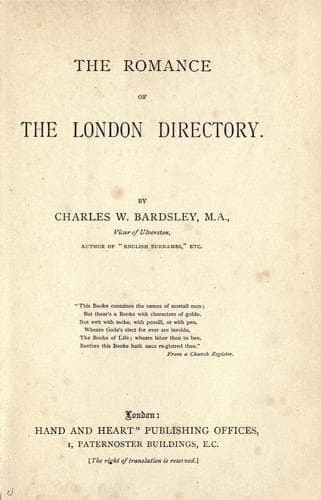
The Romance of the London DirectoryBardsley, Charles Wareing Endell
History
The Romance of the London Directory
Bardsley, Charles Wareing Endell
Names, English -- England -- London; Names, Personal -- England -- London
We must not suppose, however, that there was no spirit of antagonism to
this remarkable practice, so new in origin, and yet so deeply
established. I have carefully avoided any reference to the disagreements
that led to the execution of Charles the First, and the Commonwealth. If
this era was socially vicious, it was also religiously hypocritical.
Both sides had good and bad men in their midst. A poem written in 1660,
styled a “Psalm of Mercy,” is an evident “skit” by some Royalist upon the
new taste in nomenclature. It is too long for quotation, and though not
actually ribald, is better left in its obscurity. It pokes fun at the
following names:—Rachel, Abigaile, Faith, Charity, Pru (Prudence), Ruth,
Temperance, Grace, Bathsheba, Clemence, Jude, Pris (Priscilla), Aquila,
Mercy, Thank, Dorcas, Chloe, Phœbe. It is curious to note, that while
none of these names could be found in an English register prior to 1560,
in 1660, when this satirical ballad was indited, there was not one which
was not more or less popular, not one of which I myself have not found
several instances in contemporary records. We have only to add, that
after the recital of all these names, the poet concludes with a couplet
which we cannot insert here, but which indicates very clearly that the
writer was not very much drawn to this new phase of feeling. However, if
we are to thank the Roundheads for the introduction of many really pretty
names,—names, too, awakening sweet Biblical and religious associations in
our hearts,—we must not forget that it was owing to the antagonistic
spirit of the Cavaliers that we are still in possession of not a few old
names, which, though pagan in origin, are rendered dear by their
antiquity and their relations to English life and character generations
ere the Reformation was dreamt of. Above all, we must never forget, that
whether the name be in the Bible or out of it, whether it be given at the
font or even in the registrar’s office, it is the man that sanctifies the
name, not the name the man. It was not their names that made Venn, and
Simeon, and Wilberforce venerated; but Venn, and Simeon, and Wilberforce,
by their earnest devotion and stable piety, made themselves so revered by
Christian Englishmen that their names are still uttered with that hushed
and bated breath that is the deepest demonstration of regard that human
heart can express. Let us not then regret, that if by one band of men
the treasury house of the Scriptures was ransacked for a new vocabulary
of nomenclature, to another band we owe the preservation from the death
they were threatened with, of Ralph, Walter, Dick, Harry, Cecilia, Lucy,
Beatrice, Julia, Robert, Humphry, and Edward. Again do you say, “But
they are pagan!” Prythee, friend, will you say that because Latimer bore
the pagan name of Hugh, he died “without hope,” as a dog dieth; or that
she who permitted his body to be burned, because she bore the name of
Public-domain text, read in full here on John Shaqi.
Reviews
Reviews
No reviews yet
Be the first to share your thoughts on this work.
Join the Discussion
Join the discussion
Sign in to leave a comment or review.
Sign InorCreate an account