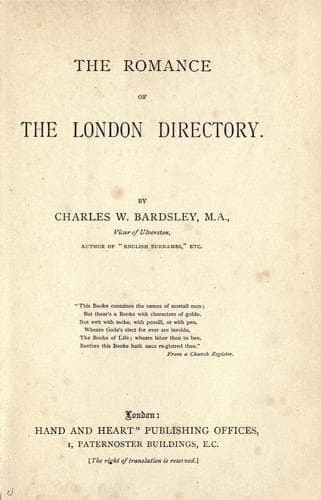
The Romance of the London DirectoryBardsley, Charles Wareing Endell
History
The Romance of the London Directory
Bardsley, Charles Wareing Endell
Names, English -- England -- London; Names, Personal -- England -- London
The earliest specimens of this peculiar spirit will be found in the reign
of Elizabeth—that is, within a score of years or so of the Reformation
and the gift of an open English Bible; so we must not suppose it was
wholly an institution of what we may term the Cromwellian period. It
reached its climax then, nothing more. In the Elizabethan “Proceedings
in Chancery” may be seen such names as Virtue Hunt, Temperance
Dowlande,—Temperance was one of our most popular names for a hundred and
fifty years,—Charitie Bowes, and Lamentation Chapman. Lamentation would
easily be affixed to a child whose mother had died in childbirth.
Ichabod has often been given for a like reason. On the contrary,
“Comfort” would be readily seized upon under circumstances of Christian
or parental joy. The other day I was in Tewkesbury Abbey, now undergoing
restoration, and, as is my wont, I began ferreting for peculiar names.
In a churchyard I instinctively walk like a dog with my nose to the
ground. Almost immediately, I came across two “Comforts,”—“Comfort, wife
of Abram Farren, died Aug. 24th, 1720,” and “Comfort Pearce, died Nov.
17th, 1715;” the latter was granddaughter of the former. Miss Holt,
whose “Mistress Margery” and other sound and thoroughly well-written
stories will have been read by most of my readers, told me not long ago
that she had seen in the register of St. James’s, Piccadilly, the
following entries:—“Repentance Tompson,” “Loving Bell,” “Obedience
Clark,” and “Unity Thornton”; “Nazareth Rudde,” also, was contained in
the same record. This reminds me of “Jerrico Segrave” in a Derbyshire
record. In that county it was very possible for Bible place-names to be
thus incorporated into personal nomenclature. Among the ruder peasantry
it was a common custom,—a custom dating from the Reformation,—to have
their child baptized by the first name the eye lighted on after the
parent had let the family Bible fall open upon the table. A clergyman
not long ago, asking in the Baptismal Service “What name?” received the
whispered rejoinder, “Ramoth Gilead.” Naturally enough, he inquired,
_sotto voce_, “A boy or a girl?” A curious instance of this general
class is to be found in the case of Frewen, Archbishop of York, who died
in 1664. He was son of a Puritan minister in Sussex; his Christian name
was “Accepted,” and his younger brother was “Thankfull.” It is from this
epoch that we must date the origin of some of our prettiest, if not now
most popular, names for girls: “Grace,” “Faith,” “Hope,” “Charity,”
“Truth,” and “Prudence.” All these have survived the era in which they,
and a hundred longer and less simple terms, were introduced; and if they
are now getting out of favour, it is only one more proof that the
fashions in detail, as well as the fashions generally, of this world,
undergo silent, it may be, but inevitable change.
Public-domain text, read in full here on John Shaqi.
Reviews
Reviews
No reviews yet
Be the first to share your thoughts on this work.
Join the Discussion
Join the discussion
Sign in to leave a comment or review.
Sign InorCreate an account