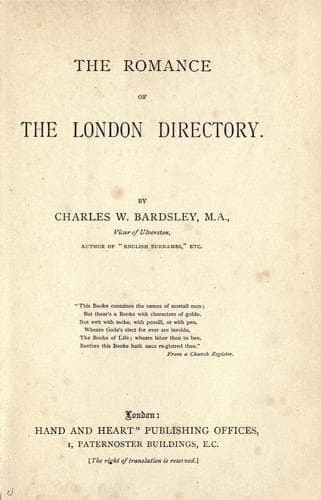
The Romance of the London DirectoryBardsley, Charles Wareing Endell
History
The Romance of the London Directory
Bardsley, Charles Wareing Endell
Names, English -- England -- London; Names, Personal -- England -- London
The Directory teems with relics of the feudal system. There is not a
single office belonging to that formal and ceremonious age which is not
commemorated within its pages. Whether it were service within the
baronial hall or tenure without, all was held by a retinue who thought no
office too mean or servile for acceptance. The feudatory, in fact, could
seemingly do nothing; everything was done for him. He could eat and
drink, ’tis true, and he did both to the great admiration of all
beholders; but he had an officer to carve his meat for him; another to
change his plate; a third to crack jokes for him, to aid his digestion; a
fourth to extend a bowl to wash his fingers; a fifth to hand him a napkin
to wipe them; a sixth to hold his wine-cup for him; and a seventh to
taste each fresh dish set before him, so that in case poison had been put
in the food, his taster might drop down dead instead of himself. Why the
baron hadn’t an officer to wipe his nose for him, I can’t say; it has
always been a mystery to me. One thing, however, is certain. As he sat
and ate and drank, he had a little crowd of officers who thought it only
too high a distinction to perform duties so menial, that a scullion in
the present day, if asked to undertake some of them, would probably
reply, “Is thy servant a dog, that he should do this thing?” At any
rate, he would give you a month’s notice, to a certainty.
That all these officerships existed, the Directory still shows; for I
have no hesitation in saying that the finest and most trustworthy records
of the feudal age are to be found, not in the British Museum in Great
Russell Street, nor the Bodleian Library at Oxford, but in that great
red-backed tome which lies on the shelf in every London warehouse.
Imagine our going to these dry and prosaic emporiums of merchandise for
an account of a long past state of life, which, with all its barbarism,
is well-nigh the most poetical era of English history. I mentioned seven
officers who tended the baron at his meals. Taking the Directory, I find
twelve Carvers, two Sewers, eleven Napiers and Nappers, six Ewers, one
hundred and twenty-five Pages, not to mention our various “Cuppages”
(_i.e._ Cup-page), Smallpages, and Littlepages, six “Says,” and
twenty-four “Sayers.” ’Tis true there are no “Fools” in the Directory,
though there may be plenty out of it; but once it was a very common name
indeed, and denoted the _officer_, if I may use the term, whose duty it
was to convulse the table with laughter by making the most ludicrous
jokes he could invent, backing them up with all sorts of grimaces and
contortions. He was a professed punster, too, and had free licence to
make them at the expense even of his lord. Indeed, the fool could make a
joke with impunity, which would have cost any other man his head. Of
course he wore a fool’s-cap as the insignia of his office. The Napier,
or Napper, set the napkins, once called “napes.” A curious and silly
Public-domain text, read in full here on John Shaqi.
Reviews
Reviews
No reviews yet
Be the first to share your thoughts on this work.
Join the Discussion
Join the discussion
Sign in to leave a comment or review.
Sign InorCreate an account