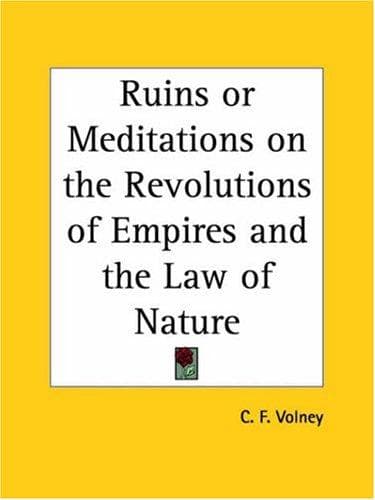
The Ruins; Or, Meditation on the Revolutions of Empires and the Law of NatureVolney, C.-F. (Constantin-François)
Religion
The Ruins; Or, Meditation on the Revolutions of Empires and the Law of Nature
Volney, C.-F. (Constantin-François)
Ethics; History -- Philosophy; Religions; Revolutions
We raise you to-day above us, that you may better discover the whole of
our relations, and be above the reach of our passions. But remember that
you are our fellow-citizens; that the power we confer on you is our own;
that we deposit it with you, but not as a property or a heritage; that
you must be the first to obey the laws you make; that to-morrow you
redescend among us, and that you will have acquired no other right but
that of our esteem and gratitude. And consider what a tribute of glory
the world, which reveres so many apostles of error, will bestow on the
first assembly of rational men, who shall have declared the unchangeable
principles of justice, and consecrated, in the face of tyrants, the
rights of nations.
CHAPTER XVII.
UNIVERSAL BASIS OF ALL RIGHT AND ALL LAW.
The men chosen by the people to investigate the true principles of
morals and of reason then proceeded in the sacred object of their
mission; and, after a long examination, having discovered a fundamental
and universal principle, a legislator arose and said to the people:
Here is the primordial basis, the physical origin of all justice and of
all right.
Whatever be the active power, the moving cause, that governs the
universe, since it has given to all men the same organs, the same
sensations, and the same wants, it has thereby declared that it has
given to all the same right to the use of its treasures, and that all
men are equal in the order of nature.
And, since this power has given to each man the necessary means of
preserving his own existence, it is evident that it has constituted them
all independent one of another; that it has created them free; that no
one is subject to another; that each one is absolute proprietor of his
own person.
Equality and liberty are, therefore, two essential attributes of man,
two laws of the Divinity, constitutional and unchangeable, like the
physical properties of matter.
Now, every individual being absolute master of his own person, it
follows that a full and free consent is a condition indispensable to all
contracts and all engagements.
Again, since each individual is equal to another, it follows that the
balance of what is received and of what is given, should be strictly in
equilibrium; so that the idea of justice, of equity, necessarily imports
that of equality.*
* The etymology of the words themselves trace out to us this
connection: equilibrium, equalitas, equitas, are all of one
family, and the physical idea of equality, in the scales of
a balance, is the source and type of all the rest.
Equality and liberty are therefore the physical and unalterable basis
of every union of men in society, and of course the necessary and
generating principle of every law and of every system of regular
government.*
Public-domain text, read in full here on John Shaqi.
Reviews
Reviews
No reviews yet
Be the first to share your thoughts on this work.
Join the Discussion
Join the discussion
Sign in to leave a comment or review.
Sign InorCreate an account