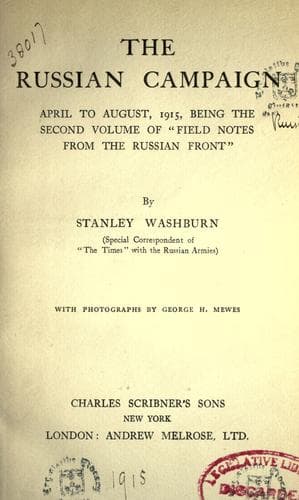
The Russian Campaign, April to August, 1915: Being the Second Volume of "Field Notes from the Russian Front"Washburn, Stanley
History
The Russian Campaign, April to August, 1915: Being the Second Volume of "Field Notes from the Russian Front"
Washburn, Stanley
World War, 1914-1918 -- Campaigns -- Eastern Front; World War, 1914-1918 -- Personal narratives
As we sped down this three miles one felt a certain satisfaction that
one had a 95 horsepower Napier capable of doing 80 miles an hour. A
third of the town itself was destroyed by the German shell fire. The
rest was like a city of the dead. Not a human being of the population
was to be seen in the streets, which but a week ago were swarming with
people. Here and there a soldier from the near-by positions lounged on
an abandoned doorstep, or napped peacefully under one of the trees in
the square. The sun of noon looked down upon a deserted village, if one
does not count an occasional dog prowling about, or one white kitty
sitting calmly on a window ledge in the sunshine casually washing her
face. As ruins have long ceased to attract us, we did not loiter long
here, but turned eastward along the great white road that led back in
the direction of Warsaw.
There is one strip of this road which I suppose is not more than 4,500
yards from the German gun positions. Personally I am always interested
in these matters, and being of an inquiring turn of mind I asked my
friend the Russian officer, who was with me in the car, if he thought
the enemy could see us. “Oh yes,” he replied quite cheerfully. “I am
sure they can see us, but I don’t think they can hit us. Probably they
won’t try, as they are not wasting ammunition as much as they used to.
Won’t you have a cigarette?” I accepted the smoke gladly and concluded
that it is the Russian custom to offer one a cigarette every time one
asks this question about the German guns. Anyway, I got exactly the
same reply from this man as I did from the other in the morning.
Ten miles up the road we came on a bit of forest where the unfortunate
villagers who had been driven out by shell fire were camping. Here they
were in the wood living in rude lean-to’s, surrounded by all their
worldly possessions that they had the means of getting away. Cows,
ducks, pigs, and chicken roamed about the forests, while dozens of
children played about in the dust.
One picture I shall not forget. Before a hut made of straw and branches
of trees a mother had constructed a rude oven in the earth by setting
on some stones the steel top of the kitchen stove that she had brought
with her. Kneeling over the fire she was preparing the primitive
noonday meal. Just behind was a cradle in which lay a few weeks’ old
baby rocked by a little sister of four. Three other little children
stood expectantly around the fire, their little mouths watering for the
crude meal that was in preparation. Behind the cradle lay the family
cow, her soft brown eyes gazing mournfully at the cradle as she chewed
reflectively at her cud. In the door of the miserable little shelter
stretched a great fat sow sleeping sweetly with her lips twitching
nervously in her sleep. An old hen with a dozen chicks was clucking to
her little brood within the open end of the hut. This was all that war
had left of one home.
Public-domain text, read in full here on John Shaqi.
Reviews
Reviews
No reviews yet
Be the first to share your thoughts on this work.
Join the Discussion
Join the discussion
Sign in to leave a comment or review.
Sign InorCreate an account