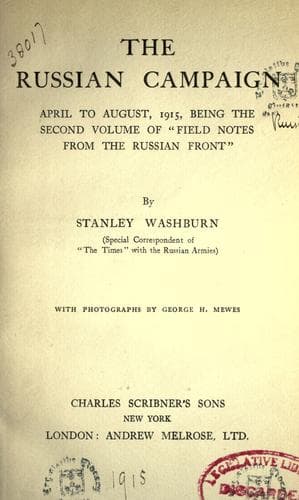
The Russian Campaign, April to August, 1915: Being the Second Volume of "Field Notes from the Russian Front" — John Shaqi
The Russian Campaign, April to August, 1915: Being the Second Volume of "Field Notes from the Russian Front"Washburn, Stanley
History
The Russian Campaign, April to August, 1915: Being the Second Volume of "Field Notes from the Russian Front"
Washburn, Stanley
World War, 1914-1918 -- Campaigns -- Eastern Front; World War, 1914-1918 -- Personal narratives
[Illustration: Telephoning to the battery from the observation
position.]
A hundred yards away a gang of labourers was digging in the forest.
It is no wonder that the mother looks nervously from her fire at
their work. Perhaps she wonders what they are about. We know. It is
another line of trenches. From what we have seen of the front line we
believe they will not be needed, but it is not strange that these poor
fugitives look on with anxious eyes with the question written large on
every face. Probably to them the war seems something from which they
cannot escape. They came to this wood for safety and now again they see
more digging of trenches going on.
Another hour on the road brings us back to the head-quarters of the
army and our day in May is over.
THE CHANGE OF FRONT IN POLAND AND THE BATTLE OF OPATOV
CHAPTER VIII
THE CHANGE OF FRONT IN POLAND AND THE BATTLE OF OPATOV
Dated:
OPATOV, POLAND,
_May 31, 1915_.
For the last three days I have been with a certain army of the Russians
that occupies the strip of Poland between the Pilitza river and the
Vistula on the south. I feel intense regret that the restrictions of
the censor proscribe the identification of military units or of their
definite location. These wonderful corps, divisions and battalions
should, in my view, have all the honour that is their due, but the
writer can only abide by the wishes of the authorities by whose
kindness and courtesy he has been able to visit these positions.
Leaving Warsaw in a motor car in the evening, and running until an
early hour in the morning, we found ourselves the next day at the
head-quarters of one of the really great army commanders of Russia.
With him and the members of his staff we spent the chief part of the
morning, when every opportunity was given us to study the situation
within his jurisdiction. To go to the Front, as I have often written
before, means a two to three days’ trip, and the inspection of a
single detail of the vast operations that have been conducted. At the
suggestion of the Commander we decided to visit a certain army corps
in the south, whose success in the operations attending the change of
front had been so extraordinary, that everyone at the staff was filled
with pride and eager to have its work appreciated. Before going on to
describe the work of this particular corps it is proper to mention a
little more particularly the work of this one army as a whole since the
beginning of the war.
This army stood before Lublin during the crisis in the early days of
the war, and by uniting with that of Plevie, and the two joining with
Russky to the east of them, there resulted the first great crash to the
Austrian arms in Galicia. Later, this same army came back north and was
engaged in the terrific fighting around Ivangorod, which resulted in
the defeat of the enemy and their expulsion from Poland last autumn.
Public-domain text, read in full here on John Shaqi.
Reviews
Reviews
No reviews yet
Be the first to share your thoughts on this work.
Join the Discussion
Join the discussion
Sign in to leave a comment or review.
Sign InorCreate an account