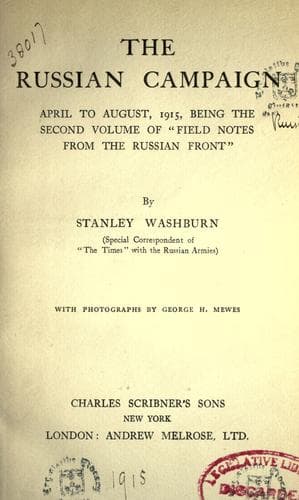
The Russian Campaign, April to August, 1915: Being the Second Volume of "Field Notes from the Russian Front"Washburn, Stanley
History
The Russian Campaign, April to August, 1915: Being the Second Volume of "Field Notes from the Russian Front"
Washburn, Stanley
World War, 1914-1918 -- Campaigns -- Eastern Front; World War, 1914-1918 -- Personal narratives
But the trouble of the enemy was not over. Ragosa at once discovered
that the 4th Landwehr division that had been hurried up to support
retreating Bredow, had been taken from the front of his neighbouring
corps, and this information he promptly passed on to his friend
commanding the -- corps who gladly passed the word on to his own front.
The regiments in that quarter promptly punched a hole in the German
weakened line, and with vicious bayonet attacks killed and captured
a large number of Germans, also forcing back their line. Something
similar happened in the corps to the south of Ragosa’s corps who were
in a fever of excitement because of the big fighting on the San, which
was going on just to their left while Ragosa’s guns were thundering
just to the north. The result was that out of a kind of sympathetic
contagion, they fixed bayonets and rushed on the enemy in their front
with a fury equal to that which was going on in both corps north of
them. Thus it came about that three quarters of this particular army
became engaged in general action by the sheer initiative of Ragosa,
and maintained it entirely by the enthusiasm of the troops engaged.
These corps even in retreat could not be restrained from going back and
having a turn with the enemy.
[Illustration: A second-line trench near Opatov.]
The change of front in Poland resulted in losses in killed, wounded and
prisoners to the enemy, approximating in this army alone between 20,000
and 30,000, with a loss to the Russians probably less than a third of
that number, besides resulting in an increase of _moral_ to the latter,
which has fully offset any depression caused by their retirement.
In talking with their officers, and I talked with at least a score,
I heard everywhere the same complaint, namely that it was becoming
increasingly difficult to keep their soldiers in the trenches. So eager
is the whole army to be advancing, that only constant discipline and
watching prevent individual units from becoming excited and getting up
and attacking, thus precipitating a general action which the Russians
wish to avoid while the movement in Galicia is one of fluctuation and
uncertainty.
Little definite information was available on this Front as to what was
going on further south, but certainly I found not the slightest sign
of depression among either men or officers with whom I talked. As one
remarked, “Well, what of it? You do not understand our soldiers. They
can retreat every day for a month and come back as full of fight at
the end of that time as when they started. A few Russian ‘defeats,’ as
the Germans call them, will be a disaster for the Kaiser. Don’t worry.
We will come back all right and it cannot be too soon for the taste of
this army.”
WITH THE ARMY IN SOUTHERN POLAND
CHAPTER IX
WITH THE ARMY IN SOUTHERN POLAND
Dated:
A CERTAIN ARMY CORPS HEAD-QUARTERS
SOMEWHERE IN SOUTHERN POLAND
_June 1, 1915_.
Public-domain text, read in full here on John Shaqi.
Reviews
Reviews
No reviews yet
Be the first to share your thoughts on this work.
Join the Discussion
Join the discussion
Sign in to leave a comment or review.
Sign InorCreate an account