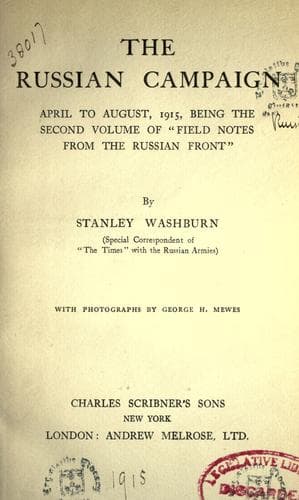
The Russian Campaign, April to August, 1915: Being the Second Volume of "Field Notes from the Russian Front"Washburn, Stanley
History
The Russian Campaign, April to August, 1915: Being the Second Volume of "Field Notes from the Russian Front"
Washburn, Stanley
World War, 1914-1918 -- Campaigns -- Eastern Front; World War, 1914-1918 -- Personal narratives
Leaving our head-quarters we drove south through a beautiful woodland
for nearly two hours, to the headquarters of that certain division of
the army which has covered itself with glory in the recent fighting
around Opatov, where we were received cordially by the commander.
Telegrams sent ahead had advised him of our arrival, and he had done
his part in arranging details that our trip might be as interesting
as possible. After a few minutes drinking tea and smoking cigarettes
we again took cars and motored for another 16 versts to the town of
Opatov, where one of the brigade head-quarters was located. This quaint
old Polish town with a castle and a wall around it has been three times
visited by the tide of battle, and the hills about it (it lies in a
hollow) are pitted with the caves made by the uneasy inhabitants, whose
experience of shell fire has been disturbing. One imagines from the
number of dugouts one sees that the whole population might easily move
under ground at an hour’s notice. However, in spite of the tumult of
battles which have been fought around it, Opatov has not been scarred
by shell fire.
From here we went directly west on the road to Lagow for perhaps 5
versts, when we turned off suddenly on to a faint road and down into
a little hollow where a tiny village nestled in which we were told
we should find the head-quarters of a certain regiment that we had
come to visit. As our cars came over the crest of the hill we noticed
assembled on a flat field, that lay in the hollow, absolutely concealed
from the outside world, a block of troops standing under arms. My first
impression was that this was a couple of reserve units just going back
to the trenches to relieve their fellows. We were delighted at such a
bit of luck. On pulling up our cars by the side of the road we found
ourselves greeted by the Colonel and staff of the regiment, to whom we
were introduced by our guide. After a few words in Russian my friend
turned, his face wreathed in smiles, and said, “The Colonel is very
kind; he has ordered a review for your inspection.”
With the staff we strolled up to the centre of the field, where on
two sides we faced two of the most magnificent battalions of troops
that it has ever been my fortune to see, while on the third side were
parked the machine-gun batteries of the regiment. For a few minutes we
stood in the centre of the three-sided square while the Colonel, with
unconcealed pride, told us something of the history of the regiment
that stood before us. Its name and its corps must not be mentioned,
but it is permissible to say that it is from Moscow and is one of the
oldest regiments in the Russian service, with traditions running
back for 125 years. It is one of the two formations of the entire
Russian army which is permitted to march in review with fixed bayonets,
a distinction acquired by 125 years of history marked by successful
work with cold steel.
[Illustration: March-past of the Gonogoriski Regiment.]
Public-domain text, read in full here on John Shaqi.
Reviews
Reviews
No reviews yet
Be the first to share your thoughts on this work.
Elsewhere in the archive
Join the Discussion
Join the discussion
Sign in to leave a comment or review.
Sign InorCreate an account