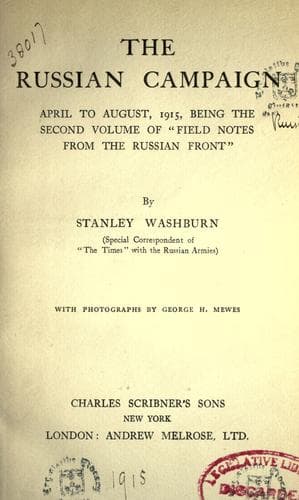
The Russian Campaign, April to August, 1915: Being the Second Volume of "Field Notes from the Russian Front"Washburn, Stanley
History
The Russian Campaign, April to August, 1915: Being the Second Volume of "Field Notes from the Russian Front"
Washburn, Stanley
World War, 1914-1918 -- Campaigns -- Eastern Front; World War, 1914-1918 -- Personal narratives
After a few pleasantries he asked what it was that we would most like,
and I replied in my stock phrases, “Observation points and trenches, if
you please.” He stood for a moment studying the tip of his dusty boot;
evidently he was not very eager about the job. However, he shrugged
his shoulders and went back to the telephone, and after a few minutes
conversation came back and said to us: “It is a very bad time to go
into our trenches, as we have no covered ways, and in the daytime one
is seen, and the enemy always begin firing. It is very unsafe, but if
you are very anxious I shall permit one of you to go forward, though it
is not convenient. When the enemy begin to fire, our batteries reply,
and firing starts in all the trenches. The soldiers like to fight, and
it doesn’t take much to start them.”
Put in this way none of us felt very keen about insisting. So we all
compromised by a visit to a secondary position, which we were told was
not very dangerous, as the enemy could only reach it with their shell
fire and “of course no one minds that,” as the officer casually put it.
We all agreed that, of course, we did not mind that, and so trooped off
with the Colonel to the trenches and dug-outs where the troops who
were not in the firing line were in immediate reserve.
The group of dug-outs was flanked with trenches, for, as the Colonel
informed us, “Who knows when this position may be attacked?” And then
he added, “You see, though we are not in the direct view of the enemy
here, they know our whereabouts and usually about this time of day they
shell the place. They can reach it very nicely and from two different
directions. Yesterday it became so hot in our house that we all spent a
quiet afternoon in the dug-outs.” He paused and offered us a cigarette,
and as he did so there came a deep boom from our rear and a howitzer
shell wailed over our heads on its mission of protest to the Austrians
about firing on Red Cross wagons. A few seconds later the muffled
report of its explosion came back across the valley. A second later
another and another shell went over our heads. The Colonel smiled, “You
see,” he said, “my orders are being carried out. No doubt the enemy
will reply soon.”
His belief was justified. A moment later that extremely distressing
sound made by an approaching shell came to our ears, followed
immediately by its sharp report as it burst in a field a few hundred
yards away. I looked about at the soldiers and officers around me, but
not one even cast a glance in the direction of the smoke drifting away
over the field near by. After wandering about his position for half or
three-quarters of an hour, we returned to the cottage. It consisted of
but three rooms. The telephone room, a little den where the officers
ate, and a large room filled with straw on which they slept at night,
when sleeping was possible.
Public-domain text, read in full here on John Shaqi.
Reviews
Reviews
No reviews yet
Be the first to share your thoughts on this work.
Elsewhere in the archive
Join the Discussion
Join the discussion
Sign in to leave a comment or review.
Sign InorCreate an account