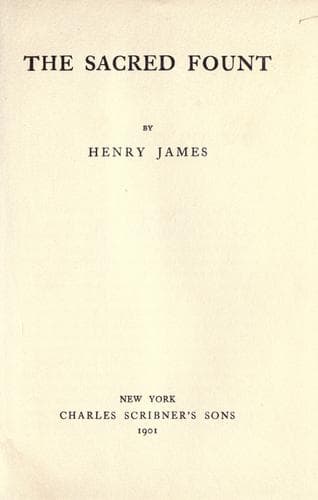
Man-woman relationships -- England -- Fiction; Married people -- England -- Fiction; Psychological fiction
But we were, alas! all too much there, too much tangled and involved for
that; every actor in the play that had so unexpectedly insisted on
constituting itself for me sat forth as with an intimation that they
were not to be so easily disposed of. It was as if there were some last
act to be performed before the curtain could fall. Would the definite
dramatic signal for ringing the curtain down be then only--as a grand
climax and _coup de théâtre_--the due attestation that poor Briss had
succumbed to inexorable time and Mrs. Server given way under a cerebral
lesion? Were the rest of us to disperse decorously by the simple action
of the discovery that, on our pianist's striking his last note, with its
consequence of permitted changes of attitude, Gilbert Long's victim had
reached the point of final simplification and Grace Brissenden's the
limit of age recorded of man? I could look at neither of these persons
without a sharper sense of the contrast between the tragedy of their
predicament and the comedy of the situation that did everything for them
but suspect it. They had truly been arrayed and anointed, they had
truly been isolated, for their sacrifice. I was sufficiently aware even
then that if one hadn't known it one might have seen nothing; but I was
not less aware that one couldn't know anything without seeing all; and
so it was that, while our pianist played, my wandering vision played and
played as well. It took in again, while it went from one of them to the
other, the delicate light that each had shed on the other, and it made
me wonder afresh what still more delicate support they themselves might
not be in the very act of deriving from their dim community. It was for
the glimmer of this support that I had left them together two or three
hours before; yet I was obliged to recognise that, travel between them
as my fancy might, it could detect nothing in the way of a consequent
result. I caught no look from either that spoke to me of service
rendered them; and I caught none, in particular, from one of them to the
other, that I could read as a symptom of their having compared notes.
The fellow-feeling of each for the lost light of the other remained for
me but a tie supposititious--the full-blown flower of my theory. It
would show here as another flower, equally mature, for me to have made
out a similar dim community between Gilbert Long and Mrs. Brissenden--to
be able to figure them as groping side by side, proportionately, towards
a fellowship of light overtaken; but if I failed of this, for ideal
symmetry, that seemed to rest on the general truth that joy brings
people less together than sorrow.
Public-domain text, read in full here on John Shaqi.
Reviews
Reviews
No reviews yet
Be the first to share your thoughts on this work.
Elsewhere in the archive
Join the Discussion
Join the discussion
Sign in to leave a comment or review.
Sign InorCreate an account