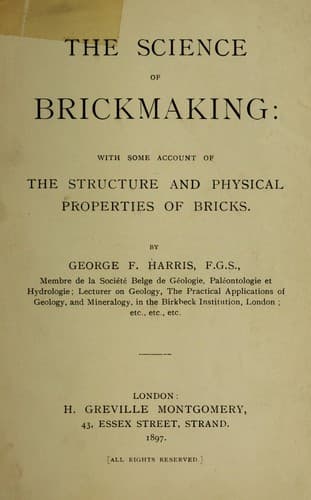
The Science of BrickmakingHarris, George Frederick
Science
The Science of Brickmaking
Harris, George Frederick
Brickmaking -- Handbooks, manuals, etc.
At Saarbrücken, in the Rhenish Province of Germany, a material known as
“iron brick” is manufactured. It is made by mixing equal proportions of
finely-ground red clay-slate with fine clay, and adding 5 per cent. of
iron ore. This mixture is then treated with a 25 per cent. solution of
sulphate of iron, together with a certain quantity of finely divided
iron ore. It is then moulded and baked in a special manner. We do not
intend to describe the chemical composition of the various volcanic
ashes, trass, and other volcanic ejectamenta used for brickmaking on
the Continent in several localities. The materials of which glass-sand
bricks, slag-bricks, &c., are made have no special interest in
connexion with our present subject, their composition naturally varying
according to the particular kinds of “refuse” employed.
CHAPTER IX.
DRYING AND BURNING.
Of the merely mechanical aspects of the operations of drying and
burning bricks, we shall say little or nothing. But there are just a
few points of a more or less scientific nature that offer themselves at
this juncture to which we desire to allude.
The brickmaker hardly needs to be told that if he places his bricks
in the sun to dry, they, or a large percentage of them, will crack,
and become practically worthless from a commercial standpoint. To dry
a brick properly in the open air is a lengthy operation--too lengthy
for many manufacturers, who, in consequence, have had recourse to
artificial drying. Many a brickyard has had to be abandoned from the
inability of the worker to produce bricks that did not crack at some
period of the operation, either in the drying, or burning, or both. And
several manufacturers have their particular methods of “doctoring” the
raw earths to prevent cracking. These are invariably “trade secrets;”
though usually of a very open and transparent character, however, to
the student of the subject.
It is most curious to learn the different reasons for adding this or
that ingredient to the earths to prevent the brick from cracking. One
who in a district has found that the addition of a little sand is
beneficial, imparts that information by degrees, either personally or
through his workmen, and in time it is laid down as a general axiom
that “sand will prevent cracking.” Another has discovered that clay
should be mixed in small quantity to produce the desired result, so
he and his neighbours do that, and pity the ignorance of the “sand
mixers.” A third feels quite certain that crushed brick, or brick dust,
is a good thing; while a fourth will add a little lime. Now, each of
these ingredients is useful in its way; everything depends upon the
class of brick-earth to be dealt with. It may happen that what will,
in a measure, prevent cracking, will be a bad thing in the burning,
and the art of the brickmaker is to know what to do under the varied
conditions.
Public-domain text, read in full here on John Shaqi.
Reviews
Reviews
No reviews yet
Be the first to share your thoughts on this work.
Join the Discussion
Join the discussion
Sign in to leave a comment or review.
Sign InorCreate an account