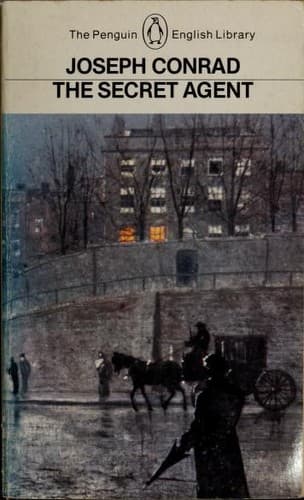
Anarchists -- Fiction; Bombings -- Fiction; Conspiracies -- Fiction; London (England) -- Fiction; Political fiction
“Frankly now, could she have been really inspired?” he queried, with
grave irony, keeping his back to the room, as if entranced by the
contemplation of the town’s colossal forms half lost in the night. He
did not even look round when he heard the mutter of the word
“Providential” from the principal subordinate of his department, whose
name, printed sometimes in the papers, was familiar to the great public
as that of one of its zealous and hard-working protectors. Chief
Inspector Heat raised his voice a little.
“Strips and bits of bright tin were quite visible to me,” he said.
“That’s a pretty good corroboration.”
“And these men came from that little country station,” the Assistant
Commissioner mused aloud, wondering. He was told that such was the name
on two tickets out of three given up out of that train at Maze Hill. The
third person who got out was a hawker from Gravesend well known to the
porters. The Chief Inspector imparted that information in a tone of
finality with some ill humour, as loyal servants will do in the
consciousness of their fidelity and with the sense of the value of their
loyal exertions. And still the Assistant Commissioner did not turn away
from the darkness outside, as vast as a sea.
“Two foreign anarchists coming from that place,” he said, apparently to
the window-pane. “It’s rather unaccountable.”’
“Yes, sir. But it would be still more unaccountable if that Michaelis
weren’t staying in a cottage in the neighbourhood.”
At the sound of that name, falling unexpectedly into this annoying
affair, the Assistant Commissioner dismissed brusquely the vague
remembrance of his daily whist party at his club. It was the most
comforting habit of his life, in a mainly successful display of his skill
without the assistance of any subordinate. He entered his club to play
from five to seven, before going home to dinner, forgetting for those two
hours whatever was distasteful in his life, as though the game were a
beneficent drug for allaying the pangs of moral discontent. His partners
were the gloomily humorous editor of a celebrated magazine; a silent,
elderly barrister with malicious little eyes; and a highly martial,
simple-minded old Colonel with nervous brown hands. They were his club
acquaintances merely. He never met them elsewhere except at the
card-table. But they all seemed to approach the game in the spirit of
co-sufferers, as if it were indeed a drug against the secret ills of
existence; and every day as the sun declined over the countless roofs of
the town, a mellow, pleasurable impatience, resembling the impulse of a
sure and profound friendship, lightened his professional labours. And
now this pleasurable sensation went out of him with something resembling
a physical shock, and was replaced by a special kind of interest in his
work of social protection—an improper sort of interest, which may be
defined best as a sudden and alert mistrust of the weapon in his hand.
CHAPTER VI
Public-domain text, read in full here on John Shaqi.
Reviews
Reviews
No reviews yet
Be the first to share your thoughts on this work.
Elsewhere in the archive
Join the Discussion
Join the discussion
Sign in to leave a comment or review.
Sign InorCreate an account