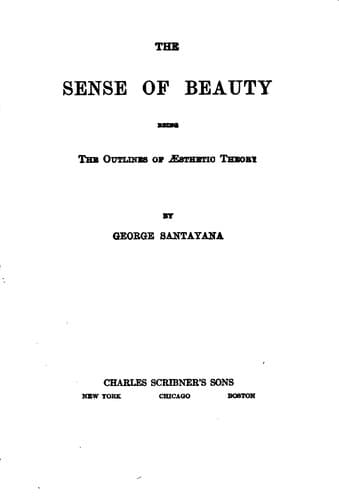
The Sense of Beauty: Being the Outlines of Aesthetic Theory — John Shaqi
The Sense of Beauty: Being the Outlines of Aesthetic TheorySantayana, George
Philosophy
The Sense of Beauty: Being the Outlines of Aesthetic Theory
Santayana, George
Aesthetics
Even the most sensuous of English poets, in whom the love of
beauty is supreme, cannot keep long to the primal elements of
beauty; the higher flight is inevitable for him. And how much does
not the appeal to things in argosy transferred from Fez, reinforced
with the reference to Samarcand and especially to the authorized
beauties of the cedars of Lebanon, which even the Puritan may
sing without a blush, add to our wavering satisfaction and
reconcile our conscience to this unchristian indulgence of sense!
But the time may be near when such scruples will be less common,
and our poetry, with our other arts, will dwell nearer to the
fountain-head of all inspiration. For if nothing not once in sense is
to be found in the intellect, much less is such a thing to be found in
the imagination. If the cedars of Lebanon did not spread a grateful
shade, or the winds rustle through the maze of their branches, if
Lebanon had never been beautiful to sense, it would not now be a
fit or poetic subject of allusion. And the word "Fez" would be
without imaginative value if no traveller had ever felt the
intoxication of the torrid sun, the languors of oriental luxury, or,
like the British soldier, cried amid the dreary moralities of his
native land: --
Take me somewhere east of Suez
Where the best is like the worst,
Where there ain't no ten commandments
And a man may raise a thirst.
Nor would Samarcand be anything but for the mystery of the
desert and the picturesqueness of caravans, nor would an argosy be
poetic if the sea had no voices and no foam, the winds and oars no
resistance, and the rudder and taut sheets no pull. From these real
sensations imagination draws its life, and suggestion its power.
The sweep of the fancy is itself also agreeable; but the superiority
of the distant over the present is only due to the mass and variety
of the pleasures that can be suggested, compared with the poverty
of those that can at any time be felt.
_Sound._
Public-domain text, read in full here on John Shaqi.
Reviews
Reviews
No reviews yet
Be the first to share your thoughts on this work.
Join the Discussion
Join the discussion
Sign in to leave a comment or review.
Sign InorCreate an account