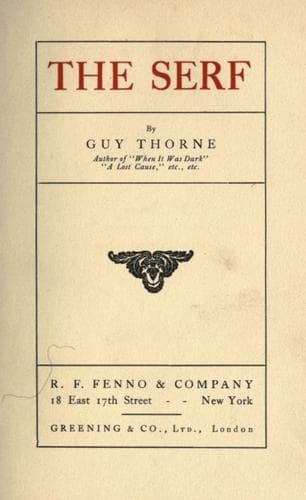
Great Britain -- History -- Stephen, 1135-1154 -- Fiction; Murder -- Fiction; Revenge -- Fiction; Serfs -- Fiction
Down below, over all the castle works, men were busy at the defences,
clustering on the walls like a swarm of flies. Presently, one by one,
torches flared out, so that work might still go on when it was dark.
Lewin leaned over the parapet and surveyed the dusky world, full of
trouble and despair. A great truth came to him. He realised that he had
been born too soon, and was not made for that age of blood and steel.
The solitary isolation of the tower top intensified the loneliness of
his own soul.
Surveying life and its possibilities for him, he could see nothing but
misery in it. As the unseen nightwinds began to fly round him and
whisper, he took a resolve. When this siege began and Lord Roger
attacked Hilgay, he would arm and go out to death, seeking it in some
brave adventure. He would give up, he thought, his treason plot with
Anselm. There was nothing else that he could do, there was no
enjoyment--every man he knew was the same, the same, ever-lastingly the
same. Life was dull. He laughed a bitter, despairing laugh, and went
down to the castle again.
There was a great carouse that evening at Hilgay, for the works were
nearly done, and a spy had brought word that the forces of Lord Roger
were not as strong as earlier reports had led them to believe.
While the candles burnt all night by the grave in the chapel, all the
castle garrison, with the exception of the sentries, got most gloriously
drunk. Lewin was no exception.
It is a relief to turn from the contemplation of that sordid, evil place
to the quiet of the Priory in the lake. Yet it must be remembered that
Hilgay is an exact type of hundreds of other strongholds existing in
England at that time. The incalculable wickedness of the space of years,
when the secluded historian wrote that "Christ and all His angels seemed
asleep," is very difficult to imagine.
In truth, it was a bestial, malignant, inhuman time. We are not grateful
enough for the blessings of to-day. Imagine, if you please, what these
people were.
There is no need to outrage our nice tastes by revolting detail. Realism
can be pushed too far. But, for the sake of a clear understanding, take
Baron Fulke of Hilgay, and listen to a few personal details.
The beast was a very well-bred man. That is to say, he was of the
aristocracy, a peer with a great record of birth. We have seen that he
stripped his mistress naked, and had her killed by rough scoundrels in
his pay. He never had a qualm. So much for his character, which was as
much like the legendary devil as may be. But about the man as a
personality.
Supposing that we could draw a parallel between that time and our own
time. Fulke would correspond to half a dozen young gentlemen we all
know, considered from the point of view of social status. A boy we meet
at a dance, or a dinner, who is a member of a great family, for example.
Public-domain text, read in full here on John Shaqi.
Reviews
Reviews
No reviews yet
Be the first to share your thoughts on this work.
Elsewhere in the archive
Join the Discussion
Join the discussion
Sign in to leave a comment or review.
Sign InorCreate an account