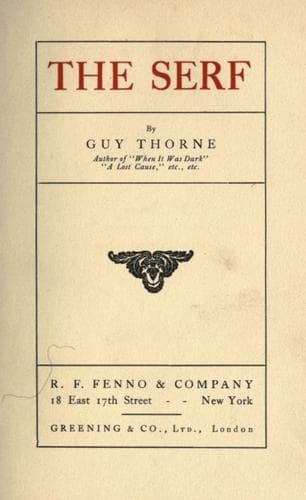
Great Britain -- History -- Stephen, 1135-1154 -- Fiction; Murder -- Fiction; Revenge -- Fiction; Serfs -- Fiction
The prior concluded with considerable vehemence. No one was more
theoretically conservative than he, and although, in this time of
anarchy, he approved of Hyla's deed, yet it certainly shocked his
instinctive respect for _les convenances_. It would have been difficult
to find a better creature than the fat prior of Icomb, a man more truly
charitable, or of a more pious life. But, had the course of this story
been different, and had Hyla lived his life at the monastery, he could
never have risen in the social scale. If the prior had discovered the
force of the man, his potentialities as a social force, he would have
sternly repressed them. Hyla's duty was to work, and be fed for his
work. The Catholic Church, with its vast hierarchy, its huge social
machinery, crushed all progress in the direction of freedom. No doubt,
Richard Espec, worthy gentleman though he was, would have been
considerably surprised if he had been told that he would be as Hyla,
and no more, in heaven. We hear too much about the humility of the
priesthood in the early Middle Ages. Of course, the great political
churchmen, such as Henry of Winchester or Thurston of York, were petty
kings, with ceremonial courts and armies. People knelt as they passed,
because they were princes as well as priests. But there is a delusion
that the ordinary monk or priest was, in effect, a perfect radical,
holding doctrines of equality, at any rate, as far as he himself was
concerned. Nothing of the sort was possible in the face of the one
crushing social fact of serfdom. Richard Espec would have washed Hyla's
feet with pleasure--there was precedent, and it was a formal act of
humiliation. At the same time, he would not have made his bed in Hyla's
hut or sat with him at meat.
The sub-prior received his superior's remarks with due reverence, and
the talk glided into other channels. While they sat there came footsteps
running down the cloister, and then a beating at the door. A young monk
entered, breathless, and knelt before the prior.
Public-domain text, read in full here on John Shaqi.
Reviews
Reviews
No reviews yet
Be the first to share your thoughts on this work.
Elsewhere in the archive
Join the Discussion
Join the discussion
Sign in to leave a comment or review.
Sign InorCreate an account