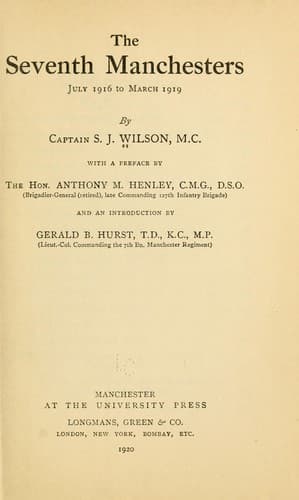
The Seventh Manchesters: July 1916 to March 1919Wilson, S. J.
History
The Seventh Manchesters: July 1916 to March 1919
Wilson, S. J.
Great Britain. Army. Manchester Regiment. Battalion, 7th (Territorial); World War, 1914-1918 -- Regimental histories -- Great Britain
As evidence of the meaning and determination of the business the
18-pounders were packed axle to axle amongst the mud and shell holes,
ready to bark forth their loud defiance to the Hun. The 4.5 howitzers
were visible in batches at various places. Further back, but still
closely packed were the 6-inch howitzers, the 60-pounders, and the
heavier calibre guns. The huge, ever popular 15-inch and large naval
guns lay beyond Ypres, and were not for the eyes of the ordinary
infantryman, but evidences of their sound work would be found when the
advance continued. It required very little imagination to picture the
German guns similarly placed and in similar numbers, for this offensive
had alarmed the enemy, for did it not threaten the existence of their
submarine bases in Belgium, to say nothing of their hold upon Lille? His
defence was careful, however, as we found to our cost, and, however much
the papers at home kept up the morale of England by sneers at the
"pill-box," the soldier on the spot regarded it with extreme caution and
respect. After all they were the only things that stood the test of this
bashing method of fighting and their very existence, when everything
else was destroyed, was ample proof of the fact. Tacticians from the
highest general to the platoon sergeant tried hard to discover the most
effective and least costly manner of "dealing with a pill-box," and the
highest in the land eagerly snatched at ideas from the man out of the
line if they bore the scent of feasibility about them.
One never knew if it was in pursuit of the solution of these tactical
problems that the higher command persisted during those sad August and
early September days in their policy of "minor" operations. Certainly no
part of the salient was ever at rest. Local attacks were launched here,
there and everywhere, but comparatively few succeeded, or if they did it
was merely a temporary success. While our advance parties were in the
line the Black Watch and the Gordons of the 15th division, executed a
night attack on "Gallipoli" and Hill 35, a job which had been previously
attempted, and very little advance was made. Those who had reached the
foremost position were immediately expelled or captured, or killed where
they stood, by the Boche counter attack next morning. Losses were very
heavy.
Public-domain text, read in full here on John Shaqi.
Reviews
Reviews
No reviews yet
Be the first to share your thoughts on this work.
Join the Discussion
Join the discussion
Sign in to leave a comment or review.
Sign InorCreate an account