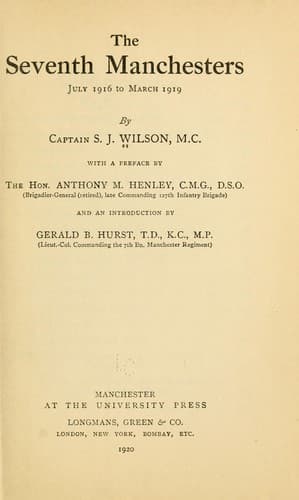
The Seventh Manchesters: July 1916 to March 1919Wilson, S. J.
History
The Seventh Manchesters: July 1916 to March 1919
Wilson, S. J.
Great Britain. Army. Manchester Regiment. Battalion, 7th (Territorial); World War, 1914-1918 -- Regimental histories -- Great Britain
The 42nd took over the right portion of this front near the Frezenburg
Ridge, and the 61st division the left. Incidentally, the latter again
attempted Hill 35 but with equal success. The 125th brigade was given
one of these unfortunate tasks, with the 6th Manchesters in support.
They were to take the Iberian, Borry and Beck Farms, now no longer
farms, but strong pill-boxes well defended by a system of outworks. They
carried out the job and suffered heavy casualties, so heavy indeed that
they could not withstand the inevitable Hun counter attack which came in
the evening and was delivered by fresh storm troops brought up for this
purpose from the rear. After they had attained their objective they
realised the peculiarity of the strength of the German defensive system.
They were subjected to heavy cross machine gun fire from the enemy
positions which had not been attacked. It was evident that unless these
latter were taken also they could not hold on. In other words, the
policy of local attacks was suicidal and was, in fact, playing into the
German scheme of defence.
While these things were taking place the 7th had moved from behind
Poperinghe to Toronto Camp near Brandhoek, where it enjoyed its full
share of the evening's excitement from Hun bombing planes. On September
7th, the battalion went by train to Ypres as far as the Asylum, and from
there filed cautiously by platoons through the town, past the ever
famous Cloth Hall, whose scraggy skeleton could be only dimly discerned
in the darkness, and through the Menin Gate. A short distance along the
Menin Road, and then we turned off and eventually got on "J" track--the
interminable length of duck boards that carried generals, privates,
rations, ammunition, runners, artillery observers, and all the other
various persons and impedimenta of war, through the maze of shell holes
up to the forward positions. There were a number of these tracks all
leading out like arteries from the bases of organisation to the front
line. They were labelled at intervals with small boards bearing the
distinctive letter or number of the track painted in white luminous
paint so that they were equally legible by day or by night. These were
the only guides in this desolate waste, and woe betide the man who in
the night came across a spot where shelling had obliterated a good
portion of the track, for it was a difficult job to pick it up again,
and frequently a nerve-racking experience.
Public-domain text, read in full here on John Shaqi.
Reviews
Reviews
No reviews yet
Be the first to share your thoughts on this work.
Join the Discussion
Join the discussion
Sign in to leave a comment or review.
Sign InorCreate an account