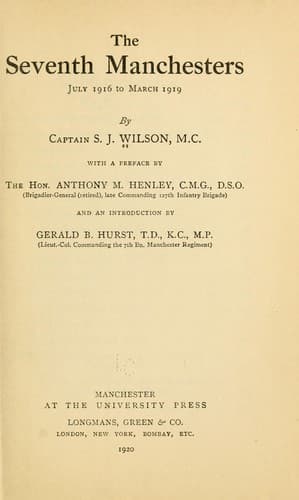
The Seventh Manchesters: July 1916 to March 1919Wilson, S. J.
History
The Seventh Manchesters: July 1916 to March 1919
Wilson, S. J.
Great Britain. Army. Manchester Regiment. Battalion, 7th (Territorial); World War, 1914-1918 -- Regimental histories -- Great Britain
Luckily the plan of attack was abandoned, and apart from a feeling of
personal relief everyone felt that a wise thing had been done. There was
little hope of the enterprise proving any more successful than that of
the L.F's., especially as similar attempts had just been made left and
right of us and had failed miserably. It was clear that the only way to
ease the situation was to carry out a big attack on a wide front.
Evidences of the imminence of such an attack showed themselves very
soon, for advance parties from the 9th division came up to learn the
front, and they intimated that they had a "big job on."
One night one of our patrols out in No Man's Land, heard not far from
them, feeble calls for help. Making their way across the shell holes
towards the sound they found a man with a smashed leg and absolutely
exhausted. He was brought in and proved to be an Inniskilling Fusilier
who had taken part in an attack some four or five weeks previously! He
stated that he had kept up his strength by eating the food and iron
rations and drinking the water which he had found upon the dead men
around him. It seemed incredible that such a thing could have happened,
but on making inquiries concerning his division, the number of which I
have forgotten, it proved to be perfectly true. Surely this case
presents physiological and psychical problems worthy of consideration.
We were relieved again by the 5th and went back to our old support
position. After two days the L.F's. came up again to relieve the
brigade, but the bulk of our battalion continued to go up in the evening
to dig in a corps cable which was being laid as far forward as possible.
By the time we completed the last of our journeys to the east of Ypres,
we were a battalion chastened in body and spirit. Many big gaps had been
made in the ranks, and it was when we settled down to the more
comfortable and peaceful existence that these gaps were keenly felt. A
most noticeable absentee was R.S.M. Hartnett. He had been badly hit by a
piece of shell at Bill Cottage, and later died in hospital at Rouen.
Hartnett's work with the 7th Manchesters has nothing but good to show.
He had been a sergeant instructor with the battalion in pre-war days,
being sent to us by the 1st Manchesters, and had gone out in 1914 to the
Soudan. He stayed on through Gallipoli, and became R.S.M. when Franklin
was made adjutant. A keen, regular, disciplinarian and the scourge of
feeble N.C.O's., he was an untiring worker in entertainments. His song
in Gallipoli--"Oh, Achi, Achi Baba," to the tune of the "Absent Minded
Beggar" will never be forgotten, while some of the sketches that he
wrote and had performed were masterpieces of good humour. C.S.M. Clough,
of "D" company, was appointed as his successor and although the post of
R.S.M. is a difficult one to fill, he did some excellent work,
particularly in the line.
Public-domain text, read in full here on John Shaqi.
Reviews
Reviews
No reviews yet
Be the first to share your thoughts on this work.
Join the Discussion
Join the discussion
Sign in to leave a comment or review.
Sign InorCreate an account