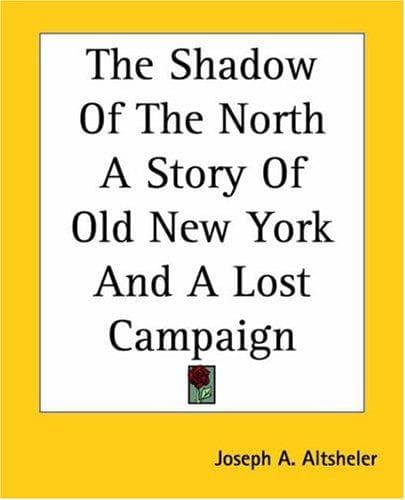
The Shadow of the North: A Story of Old New York and a Lost CampaignAltsheler, Joseph A. (Joseph Alexander)
History
The Shadow of the North: A Story of Old New York and a Lost Campaign
Altsheler, Joseph A. (Joseph Alexander)
United States -- History -- French and Indian War, 1754-1763 -- Juvenile fiction
Robert and the hunter assented gladly. Robert, in truth, was very
curious to hear what these old friends and enemies of his had to say,
and he felt a thrill when the two recognized and saluted him in the
most friendly fashion, just as if they had never meant him any harm.
"Chance brings about strange meetings between us, Mr. Lennox," said De
Courcelles. "It gives me pleasure to note that you have not yet taken
any personal harm from our siege."
"Nor you nor Monsieur de Jumonville, from our successful defense,"
replied Robert in the same spirit.
"You have us there. The points so far are in your favor, although only
superficially so, as I shall make clear to you presently."
Then De Courcelles turned his attention to Colden, who he saw was the
nominal leader of the garrison.
"My name," he said, "is Auguste de Courcelles, a colonel in the
service of His Majesty, King Louis of France. My friend is Captain
Francois de Jumonville, and we have the honor to lead the numerous and
powerful force of French and Indians now besieging you."
"And my name is Colden, Captain James Colden," replied the young
officer. "I've heard of you from my friends, Mr. Lennox and
Mr. Willet, and I have the honor of asking you what I can do for you."
"You cannot do for us more than you can do for yourself, Captain
Colden. We ask the surrender of your little fort, and of your little
garrison, which we freely admit has defended itself most
gallantly. It's not necessary for us to make an assault. You're deep
in the wilderness, we can hold you here all winter, and help cannot
possibly come to you. We guarantee you good treatment in Canada, where
you will be held until the war is over."
Young Colden smiled. They were standing before the single gate in the
palisade, and he looked back at the solid buildings, erected by the
hands of his own men, with the comfortable smoke curling up against
the cold sky. And he looked also at the wintry forest that curved in
every direction.
"Colonel de Courcelles," he said, "it seems to me that we are in and
you are out. If it comes to holding us here all winter we who have
good houses can stand it much better than you who merely have the
forest as a home, where you will be rained upon, snowed upon, hailed
upon, and maybe frozen. Why should we exchange our warm house for your
cold forest?"
Colonel de Courcelles frowned. There was a humorous inflection in
Colden's tone that did not please him, and the young officer's words
also had a strong element of truth.
"It's not a time to talk about houses and forests," he said, somewhat
haughtily. "We have here a formidable force capable of carrying your
fort, and, for that reason, we demand your surrender. Indians are
always inflamed by a long and desperate resistance and while Captain
de Jumonville and I will do our best to restrain them, it's possible
that they may escape from our control in the hour of victory."
Public-domain text, read in full here on John Shaqi.
Reviews
Reviews
No reviews yet
Be the first to share your thoughts on this work.
Elsewhere in the archive
Join the Discussion
Join the discussion
Sign in to leave a comment or review.
Sign InorCreate an account