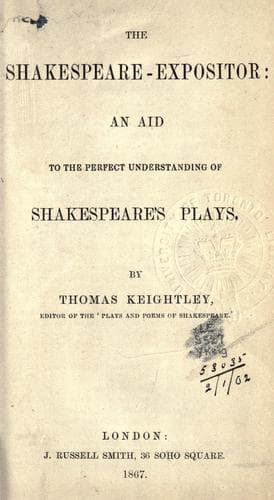
The Shakespeare-Expositor: An Aid to the Perfect Understanding of Shakespeare's PlaysKeightley, Thomas
General
The Shakespeare-Expositor: An Aid to the Perfect Understanding of Shakespeare's Plays
Keightley, Thomas
Drama -- Outlines, syllabi, etc.; Shakespeare, William, 1564-1616 -- Outlines, syllabi, etc.
In these plays we may, I think, distinguish four different phases of
composition, in each of which the thoughts and the language of the
poet present a peculiar appearance.
The _first_ phase extends we may say from 1593 to 1598, and contains
the plays in Meres's list--except 1 Henry IV., and The Merchant
of Venice, and The Taming of the Shrew. It is distinguished by a
continual play on words and by frequent rimes--both in couplets and
in stanzas--while the blank verse, which is as yet unformed, is
harmonious and almost always decasyllabic. Richard III. seems to form
the connecting link between this and the next phase; for it is free
from both rimes and play on words, while the blank verse has not yet
acquired its appropriate form.
The _second_ phase would seem to extend from 1598 to 1603. It contains
The Merchant of Venice, As You Like It, Much Ado about Nothing, The
Merry Wives of Windsor, Twelfth Night, 1 and 2 Henry IV., Henry V.,
Hamlet, Othello, Julius Cæsar, Antony and Cleopatra. Here the dramatic
blank verse is perfect, trisyllabic feet being admitted, and the lines
running into each other, rimes only appearing in final couplets. There
rarely occurs a play on words, and the language is in general easy and
natural.
The _third_ phase may extend from 1603 to 1609. It contains Measure
for Measure, Lear, Macbeth, Troilus and Cressida, Timon of Athens,
and Coriolanus. In this the poet returned to the practice of giving
passages of several lines in rime, though not in stanzas, and his
language is obscured by periphrases, inversions, and ellipses to such
an extent that many places--the speeches of Ulysses, for instance, in
Troilus and Cressida--must have been perfectly unintelligible to an
ordinary audience. He had already, as in Antony and Cleopatra, begun to
place more frequently the preposition or conjunction at the end of one
line and the word connected with it at the beginning of the next, and
he continues to do so here, chiefly in Coriolanus, though hardly at all
in Troilus and Cressida, or in Timon of Athens.
The _fourth_ and last phase contains The Winter's Tale, The Tempest,
Henry VIII., Cymbeline. He here seems to have made a return to the
simpler language of the second phase. In Henry VIII. and The Tempest,
what has been said of prepositions and conjunctions goes on to a great
extent.
* * * * *
The plays above noticed--thirty-two in number--are the genuine
productions of the poet. Two of them, King John and The Taming of the
Shrew, were founded on plays that are still extant, and we may see that
he used them precisely as he did the tales and chronicles on which he
founded so many of his other plays, taking the story, the incidents,
the characters, and, when it suited his purpose, the language which
they contained.
Public-domain text, read in full here on John Shaqi.
Reviews
Reviews
No reviews yet
Be the first to share your thoughts on this work.
Join the Discussion
Join the discussion
Sign in to leave a comment or review.
Sign InorCreate an account