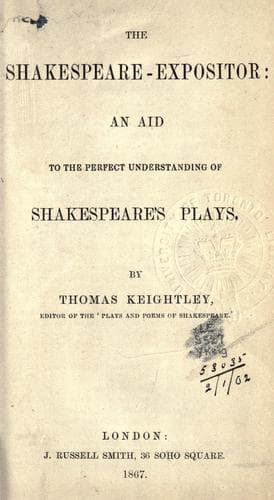
The Shakespeare-Expositor: An Aid to the Perfect Understanding of Shakespeare's PlaysKeightley, Thomas
General
The Shakespeare-Expositor: An Aid to the Perfect Understanding of Shakespeare's Plays
Keightley, Thomas
Drama -- Outlines, syllabi, etc.; Shakespeare, William, 1564-1616 -- Outlines, syllabi, etc.
_Date._ It was entered in the Stationers' Registers, January 28,
1608-9. It had not been acted at that time; for the publishers state,
in an Address to the Reader, that it had never been "staled with the
stage, never clapper-clawed with the palms of the vulgar;" while in a
reissue of it in the same year the Address was suppressed, and it was
given "as it was acted by the King's Majesty's servants at the Globe."
It is therefore evident that it was first acted in 1609; but it might
have been written some years earlier. It is a very curious question,
and one to which I am unable to give a satisfactory answer, how it came
into the hands of the publisher. I entirely disagree with those critics
who think they discern in it the hand of another poet; for there is not
a play in the whole collection more thoroughly Shakespearian in every
scene. The conclusion certainly is huddled up in a way not elsewhere to
be met with in these plays; but that is no proof of this theory; for
if Shakespeare had taken up the work of another, the conclusion is the
very part he would have been most likely to develope. It is further
very remarkable, that though this play was not exposed to the wear and
tear of the property-room, it contains more imperfect lines than almost
any other. This I can only attribute to the haste and carelessness
of the transcriber, who, as working surreptitiously, was anxious to
hurry through his task in as short a time as possible. I will observe,
in fine, that, though it contains the death of Hector--which might
perhaps better have been omitted--it is in reality a tragi-comedy, as
much so as any of Beaumont and Fletcher's.
_Origin._ Chaucer's Troilus and Cresseida, Caxton's Recuyl of the
Historyes of Troye, and Lydgate's Historye, Sege, and Destruccyon of
Troye.
TIMON OF ATHENS.
_Edition._ Only in the folio, 1623.
_Date._ We have no means of ascertaining the exact date; but the
language and the use of rimes in the dialogue induce me to think that
it was near that of Troilus and Cressida.
_Origin._ The story of Timon in Painter's Palace of Pleasure, and life
of Antony in North's Plutarch.
CORIOLANUS.
_Edition._ Only in the folio, 1623.
_Date._ A little later, I think, than the two preceding plays; for
there is only one riming passage in it.
_Origin._ Life of Coriolanus in North's Plutarch.
CYMBELINE.
_Edition._ Only in the folio, 1623.
_Date._ From the style and the family resemblance--as appears to
me--between Imogen, Miranda, and Perdita, I should deem it to be
contemporaneous with the Tempest and the Winter's Tale. We may place
it, then, in or after 1610.
_Origin._ The tale of Bernabò da Genova in the Decamerone, which
Shakespeare had probably read in the original. There was an imitation
of it in a tract called Westward for Smelts, of which, however, no
edition earlier than 1620 is known. For the historical part, he, of
course, had resorted to Hollinshed.
* * * * *
Public-domain text, read in full here on John Shaqi.
Reviews
Reviews
No reviews yet
Be the first to share your thoughts on this work.
Join the Discussion
Join the discussion
Sign in to leave a comment or review.
Sign InorCreate an account