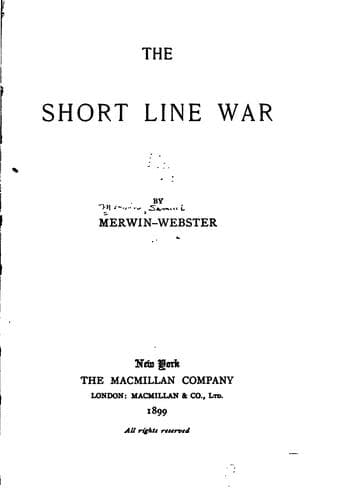
Historical fiction; Railroads -- History -- Fiction
“You must have had an afternoon full of experiences,” she said.
“Yes,” answered the Senator. “I enjoyed my drive over from Sawyerville
immensely. The weather was somewhat unpleasant, but I had an excellent
horse and we made very good time, until we got a hot-box. I was obliged
to leave the vehicle with a farmer, and walked the last two miles.”
“Indeed?” said Katherine. “But please tell me about the riot. It must
have been very exciting.”
“I hardly think it would interest a lady,” said Sporty, uneasily.
“Senator Jones,”--Katherine was speaking with much severity,--“I did not
think when I first saw you that you could prove so disagreeable.”
Sporty beamed. “It wasn't very much of a riot,” he said. “They just
hit the fireman behind the ear and put handcuffs on the engineer, and
started out to grab the road. They'll have to fight for it.”
“Was what they did legal?” she asked.
“Oh, no; not at all. It's just a hold-up.”
The Senator was saying rather more than he meant to, and he was glad
that the telephone bell broke off the conversation at this point. He
excused himself abruptly and went to have a talk with the Governor.
Katherine walked to a window and stood staring out with unseeing eyes.
At last she turned to a man who stood near her and said:--
“I don't believe it's going to rain any more. Will you have them bring
up my trap, please?”
CHAPTER XVI
McNALLY's EXPEDIENT
Katherine's casual acquaintances thought of her as a cool, unemotional
young woman, and when asked for their estimate of her would give it with
confidence that it was accurate. The few who knew her better were less
sure what they thought of her, and there was considerable diversity in
their opinions. She had a strong will and plenty of confidence in it.
Until she had found herself standing between Harvey West and her father,
she never had the least doubt that in any situation she would be able to
do what she wanted. But without knowing it she liked to let her impulses
direct her, and her confidence that her will could, if necessary,
overrule them gave them freer play than they would have had in a weaker
personality. She was keenly sensitive--and this she recognized--to the
atmosphere of her immediate environment.
Public-domain text, read in full here on John Shaqi.
Reviews
Reviews
No reviews yet
Be the first to share your thoughts on this work.
Elsewhere in the archive
Join the Discussion
Join the discussion
Sign in to leave a comment or review.
Sign InorCreate an account