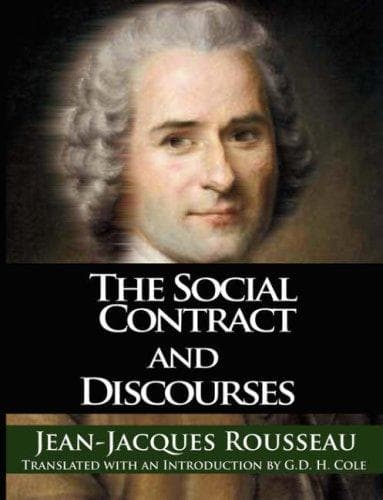
The social contract & discoursesRousseau, Jean-Jacques
Philosophy
The social contract & discourses
Rousseau, Jean-Jacques
Economics; Political science -- Early works to 1800; Social contract
By the social compact we have given the body politic existence and
life: we have now by legislation to give it movement and will. For the
original act by which the body is formed and united still in no respect
determines what it ought to do for its preservation.
What is well and in conformity with order is so by the nature of
things and independently of human conventions. All justice comes from
God, who is its sole source; but if we knew how to receive so high an
inspiration, we should need neither government nor laws. Doubtless,
there is a universal justice emanating from reason alone; but this
justice, to be admitted among us, must be mutual. Humanly speaking, in
default of natural sanctions, the laws of justice are ineffective among
men: they merely make for the good of the wicked and the undoing of
the just, when the just man observes them towards everybody and nobody
observes them towards him. Conventions and laws are therefore needed to
join rights to duties and refer justice to its object. In the state of
nature, where everything is common, I owe nothing to him whom I nave
promised nothing; I recognise as belonging to others only what is of no
use to me. In the state of society all rights are fixed by law, and the
case becomes different.
But what, after all, is a law? As long as we remain satisfied with
attaching purely metaphysical ideas to the word, we shall go on arguing
without arriving at an understanding; and when we have defined a law of
nature, we shall be no nearer the definition of a law of the State.
I have already said that there can be no general will directed to a
particular object. Such an object must be either within or outside the
State. If outside, a will which is alien to it cannot be, in relation
to it, general; if within, it is part of the State, and in that case
there arises a relation between whole and part which makes them two
separate beings, of which the part is one, and the whole minus the part
the other. But the whole minus a part cannot be the whole; and while
this relation persists, there can be no whole, but only two unequal
parts; and it follows that the will of one is no longer in any respect
general in relation to the other.
But when the whole people decrees for the whole people, it is
considering only itself; and if a relation is then formed, it is
between two aspects of the entire object, without there being any
division of the whole. In that case the matter about which the decree
is made is, like the decreeing will general. This act is what I call a
law.
Public-domain text, read in full here on John Shaqi.
Reviews
Reviews
No reviews yet
Be the first to share your thoughts on this work.
Join the Discussion
Join the discussion
Sign in to leave a comment or review.
Sign InorCreate an account