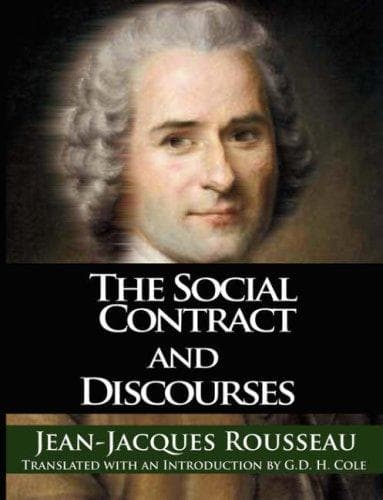
The social contract & discoursesRousseau, Jean-Jacques
Philosophy
The social contract & discourses
Rousseau, Jean-Jacques
Economics; Political science -- Early works to 1800; Social contract
Laws are, properly speaking, only the conditions of civil association.
The people, being subject to the laws, ought to be their author:
the conditions of the society ought to be regulated solely by those
who come together to form it. But how are they to regulate them? Is
it to be by common agreement, by a sudden inspiration? Has the body
politic an organ to declare its will? Who can give it the foresight to
formulate and announce its acts in advance? Or how is it to announce
them in the hour of need? How can a blind multitude, which often does
not know what it wills, because it rarely knows what is good for it,
carry out for itself so great and difficult an enterprise as a system
of legislation? Of itself the people wills always the good, but of
itself it by no means always sees it. The general will is always in
the right, but the judgment which guides it is not always enlightened.
It must be got to see objects as they are, and sometimes as they ought
to appear to it; it must be shown the good road it is in search of,
secured from the seductive influences of individual wills, taught to
see times and spaces as a series, and made to weigh the attractions
of present and sensible advantages against the danger of distant and
hidden evils. The individuals see the good they reject; the public
wills the good it does not see. All stand equally in need of guidance.
The former must be compelled to bring their wills into conformity with
their reason; the latter must be taught to know what it wills. If that
is done, public enlightenment leads to the union of understanding and
will in the social body: the parts are made to work exactly together,
and the whole is raised to its highest power. This makes a legislator
necessary.
[1] I understand by this word, not merely an aristocracy or a
democracy, but generally any government directed by the general will,
which is the law. To be legitimate, the government must be, not one
with the Sovereign, but its minister. In such a case even a monarchy is
a Republic. This will be made clearer in the following book.
CHAPTER VII
THE LEGISLATOR
In order to discover the rules of society best suited to nations,
a superior intelligence beholding all the passions of men without
experiencing any of them would be needed. This intelligence would have
to be wholly unrelated to our nature, while knowing it through and
through; its happiness would have to be independent of us, and yet
ready to occupy itself with ours; and lastly, it would have, in the
march of time, to look forward to a distant glory, and, working in one
century, to be able to enjoy in the next.[1] It would take gods to give
men laws.
Public-domain text, read in full here on John Shaqi.
Reviews
Reviews
No reviews yet
Be the first to share your thoughts on this work.
Join the Discussion
Join the discussion
Sign in to leave a comment or review.
Sign InorCreate an account