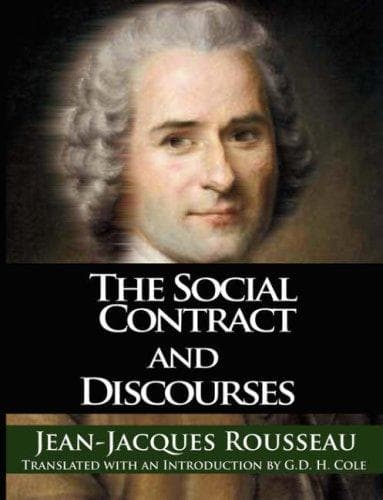
The social contract & discoursesRousseau, Jean-Jacques
Philosophy
The social contract & discourses
Rousseau, Jean-Jacques
Economics; Political science -- Early works to 1800; Social contract
Nevertheless, the decemvirs themselves never claimed the right to pass
any law merely on their own authority. "Nothing we propose to you,"
they said to the people, "can pass into law without your consent.
Romans, be yourselves the authors of the laws which are to make you
happy."
He, therefore, who draws up the laws has, or should have, no right of
legislation, and the people cannot, even if it wishes, deprive itself
of this incommunicable right, because, according to the fundamental
compact, only the general will can bind the individuals, and there
can be no assurance that a particular will is in conformity with the
general will, until it has been put to the free vote of the people.
This I have said already; but it is worth while to repeat it.
Thus in the task of legislation we find together two things which
appear to be incompatible: an enterprise too difficult for human
powers, and, for its execution, an authority that is no authority.
There is a further difficulty that deserves attention. Wise men, if
they try to speak their language to the common herd instead of its
own, cannot possibly make themselves understood. There are a thousand
kinds of ideas which it is impossible to translate into popular
language. Conceptions that are too general and objects that are too
remote are equally out of its range: each individual, having no taste
for any other plan of government than that which suits his particular
interest, finds it difficult to realise the advantages he might hope
to draw from the continual privations good laws impose. For a young
people to be able to relish sound principles of political theory and
follow the fundamental rules of statecraft, the effect would have to
become the cause; the social spirit, which should be created by these
institutions, would have to preside over their very foundation; and men
would have to be before law what they should become by means of law.
The legislator therefore, being unable to appeal to either force or
reason, must have recourse to an authority of a different order capable
of constraining without violence and persuading without convincing.
This is what has, in all ages, compelled the fathers of nations to
have recourse to divine intervention and credit the gods with their
own wisdom, in order that the peoples, submitting to the laws of the
State as to those of nature, and recognising the same power in the
formation of the city as in that of man, might obey freely, and bear
with docility the yoke of the public happiness.
Public-domain text, read in full here on John Shaqi.
Reviews
Reviews
No reviews yet
Be the first to share your thoughts on this work.
Elsewhere in the archive
Join the Discussion
Join the discussion
Sign in to leave a comment or review.
Sign InorCreate an account