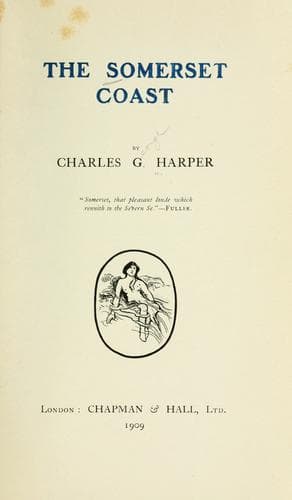
The Somerset CoastHarper, Charles G. (Charles George)
History
The Somerset Coast
Harper, Charles G. (Charles George)
Somerset (England) -- Description and travel
Travellers to or from the West by the Great Western Railway are
generally much impressed, between Yatton and Bridgwater, by the strange
solitary hill of Brent Knoll that rises abruptly from the plain of
Burnham Level, and looks oddly like some long-extinct volcano with its
cone shorn off or fallen in. Fast trains do not stop at the little
wayside station also called “Brent Knoll,” and while passengers are
still gazing curiously at the hill, they are whirled away in midst of
other interesting scenery.
Brent Knoll stands out prominently by virtue of its height of 457 feet,
as well as by its isolated situation in the great alluvial plain through
which lazily meander the muddy streams of Brue and Axe to their outlets
at Uphill and Highbridge. It is one of those many scattered heights that
are so strangely disposed about the neighbourhood of Sedgemoor, and give
so romantic an appearance to these wide-spreading levels. Of these the
most prominent, geographically and historically, is the famed
Glastonbury Tor, which with its volcanic outline, crested with the tall
tower of the ancient Chapel of St. Michael, is prominent for many a
misty mile, like some Hill of Dream. Then there is the Mump at
Boroughbridge, by the crossing of the Parret into the Isle of Athelney;
Borough Hill, near Wedmore; and many smaller, together with those
scarcely perceptible hillocks amid the marshes that are now the sites of
villages, whose very names of Chedzoy, Middlezoy, Westonzoyland, and
Othery, tell us that these, together with the larger hills, were all,
“once upon a time,” islands in a shallow sea that stagnated over the
whole of what is now called “Sedgemoor,” but is properly “Sedgemere.”
Centuries of draining, of cutting those long, broad and deep dykes
called “rhines,” that cross the moor for many miles, in every direction,
and so carry away the waters, have converted what had become, after the
sea had retired, an almost impassable morass into a fertile plain. The
industry of peat-digging in the heart of the moor shows the nature of
the soil in these parts, and modern discoveries of prehistoric
lake-dwellings at Meare, whose very name contains evidence of the mere,
or lake that once existed, indicate the manner of life these ancient
inhabitants lived. King Arthur seems a dim and distant figure to us, but
long before his time there lived a race of people on the islands of this
inland sea; folk who, although they frescoed themselves liberally with
red ochre, were by no means without a more artistic knowledge of
decoration than implied by that crude form of personal adornment. They
certainly made earthenware pottery of graceful forms, decorated with
ornament of excellent design and execution. Their other habits were
primitive. Largely a fish-eating folk, they often lived, as described
earlier in these pages, in wattled huts built on piles or stakes driven
in the waters. These forms of dwellings were readily adapted for
Public-domain text, read in full here on John Shaqi.
Reviews
Reviews
No reviews yet
Be the first to share your thoughts on this work.
Join the Discussion
Join the discussion
Sign in to leave a comment or review.
Sign InorCreate an account