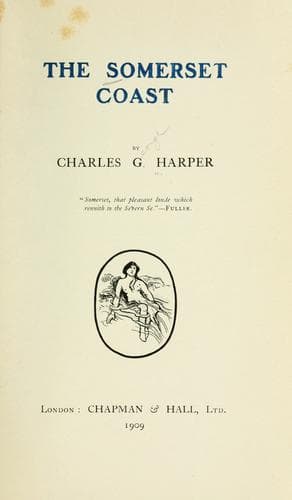
The Somerset CoastHarper, Charles G. (Charles George)
History
The Somerset Coast
Harper, Charles G. (Charles George)
Somerset (England) -- Description and travel
The unfortunate person who, clad perhaps in a light summer suit (“Gent’s
West-End lounge suit. This style 25_s._”), has unwittingly sat upon a
piece of ham-fat left behind by one of these gay irresponsibles, hates
the tripper thereafter with a baleful intensity. Can we blame him that
he does so? But this is only one of that half-day excursionist’s deadly
sins, of which the fact that he brings merely his presence and his
nosebag—and little money—into the places he favours is one of the
deadliest. Another is the circumstance that he is a Welshman. The
Somerset folk do not like the Welsh, who are alien from them in every
possible way, and it is quite certain that the South Wales colliers and
dockers are not a favourable or pleasing type. Thus triply—financially,
racially and socially—the trippers from across the Severn Sea are not a
success.
It is all very lively at Burnham, and there is a bandstand, and there
are lodging-houses and boarding-houses innumerable, and teashops, and a
“park” about the area of a moderate-sized private garden. No tramways
have yet appeared at Burnham, but it is possible to travel
expeditiously, if involuntarily and not altogether safely, and quite
freely—on the banana-skins that plentifully bestrew the streets. But
this form of locomotion is not altogether popular.
There is much motor-boating in these latter days off Burnham, and by
favour of such a craft, or by sailing-skiff, or the comparatively
tedious method of rowing, you may visit Steart Island, off the mouths of
the Brue and Parret. But there are no attractions on that flat isle,
swimming in surrounding ooze, except at such times as winter, when the
wild-fowl congregate greatly there, in the mistaken notion that they are
safe from the sportsman.
In midst of the long line of houses that closely front upon the sea,
stands the ancient parish church of Burnham; considerably below the
level of the street. The traveller who has come from Brean and Berrow
will at once perceive that this street and this roadway are founded upon
the blown sand that has placed Brean church in a similar hollow.
Here, at Burnham, the church-tower, of three storeys, leans as many
times, this way and that, and has apparently been long in this
condition, having been left so at the restoration of 1887. In the
chancel remains a portion of a huge white marble altar-piece designed by
Inigo Jones for the Chapel Royal, Whitehall, and subsequently erected in
Westminster Abbey by Sir Christopher Wren. At the coronation of George
IV. it was removed and placed here by Dr. King, Canon of Westminster and
vicar of Burnham; and singularly cumbrous and out of place it looks
still, even though parts of it have been removed, to afford much-needed
room.
Public-domain text, read in full here on John Shaqi.
Reviews
Reviews
No reviews yet
Be the first to share your thoughts on this work.
Elsewhere in the archive
Join the Discussion
Join the discussion
Sign in to leave a comment or review.
Sign InorCreate an account