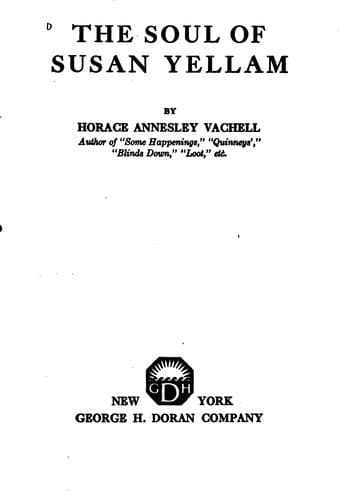
England -- Social life and customs -- 20th century -- Fiction; Villages -- England -- Fiction; World War, 1914-1918 -- Fiction
"I told my wife last night that knowledge is simply unachievable,
because the biggest men don't know yet the temper of the country. Nobody
knows. But I'll tell you this: the Government is afraid of the
Industrials, terrified of strikes, terrified of Ireland, terrified, of
course, of being kicked out. A sort of mental palsy has 'em by the
throat. They are putting out feelers, tentatively approaching everybody.
It's a sorry business. The bright spot is the response from our
Colonies; India is behaving well. That must be a rare sell for the
Kayser. Well, well; I've let off a little steam. Let's consider
ourselves and what we can do. Men must be got. In this village your dear
boy has set a glorious example."
"George Mucklow enlisted three days ago."
"So my wife tells me. I propose to give a lecture in the school-house on
elementary military dispositions, so that our people will be able to
read their papers with some sort of intelligence."
"They don't read papers--much."
"I want you to fill the school-house for me."
"With pleasure."
"We shall open a Red Cross Hospital as soon as may be, at the Court."
Hamlin promised cordial co-operation. He had never doubted the Squire's
willingness or capacity to "do his bit." And very mournfully he told
himself that, making due allowance for Sir Geoffrey's reactionary
sentiments and hatred of politicians the indictment brought by him
against the Mandarins was in the main justified. He said quietly:
"Most of my considered judgments are in the melting-pot."
"Bless my soul! I never expected to hear you say that. So are mine. The
main question for all of us is this: will the country rise to this
stupendous emergency? I suppose the mere mention of conscription gives
you a fit?"
"I carry an open mind about it."
"You amaze me, Hamlin. We were both 'blue-water school' men."
"Yes. You use the past tense. I am humbly sensible that what I have felt
and acted upon, principles and theories essentially rooted in peace and
for peace, is of the past. I shall leave them there. The needs of the
present are obsessing." He paused a moment; when he spoke again his
voice held conviction: "Out of the darkness, I see light."
Sir Geoffrey asked eagerly:
"What light?"
"The light of a happier civilisation, of a broader and more sympathetic
internationalism. The ashes of this conflagration may fertilise anew the
whole earth. It must be so."
He had surprised Sir Geoffrey a moment back; it was the Squire's turn to
surprise him. Hamlin expected a wail from the many-acred lord of the
manor, a Jeremiad personal and embittered. Inevitably the men of large
estates, with little outside their domains to support them, must suffer
cruelly. It was difficult, indeed, to envisage the Squire of
Nether-Applewhite without his shooting and hunting, with a much-reduced
establishment, constrained to cheese-paring, entertaining wounded
Tommies instead of county magnates. Sir Geoffrey answered as humbly as
the Parson:
Public-domain text, read in full here on John Shaqi.
Reviews
Reviews
No reviews yet
Be the first to share your thoughts on this work.
Elsewhere in the archive
Join the Discussion
Join the discussion
Sign in to leave a comment or review.
Sign InorCreate an account