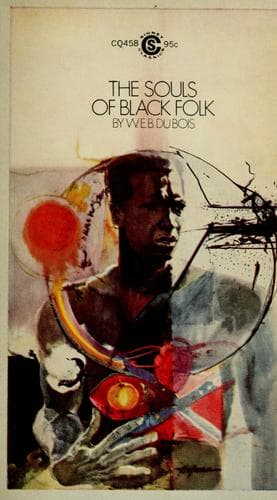
The Souls of Black FolkDu Bois, W. E. B. (William Edward Burghardt)
History
The Souls of Black Folk
Du Bois, W. E. B. (William Edward Burghardt)
African Americans
From the shimmering swirl of waters where many, many thoughts ago the
slave-ship first saw the square tower of Jamestown, have flowed down to
our day three streams of thinking: one swollen from the larger world
here and overseas, saying, the multiplying of human wants in
culture-lands calls for the world-wide cooperation of men in satisfying
them. Hence arises a new human unity, pulling the ends of earth nearer,
and all men, black, yellow, and white. The larger humanity strives to
feel in this contact of living Nations and sleeping hordes a thrill of
new life in the world, crying, “If the contact of Life and Sleep be
Death, shame on such Life.” To be sure, behind this thought lurks the
afterthought of force and dominion,—the making of brown men to delve
when the temptation of beads and red calico cloys.
The second thought streaming from the death-ship and the curving river
is the thought of the older South,—the sincere and passionate belief
that somewhere between men and cattle, God created a _tertium quid_,
and called it a Negro,—a clownish, simple creature, at times even
lovable within its limitations, but straitly foreordained to walk
within the Veil. To be sure, behind the thought lurks the
afterthought,—some of them with favoring chance might become men, but
in sheer self-defence we dare not let them, and we build about them
walls so high, and hang between them and the light a veil so thick,
that they shall not even think of breaking through.
And last of all there trickles down that third and darker thought,—the
thought of the things themselves, the confused, half-conscious mutter
of men who are black and whitened, crying “Liberty, Freedom,
Opportunity—vouchsafe to us, O boastful World, the chance of living
men!” To be sure, behind the thought lurks the afterthought,—suppose,
after all, the World is right and we are less than men? Suppose this
mad impulse within is all wrong, some mock mirage from the untrue?
So here we stand among thoughts of human unity, even through conquest
and slavery; the inferiority of black men, even if forced by fraud; a
shriek in the night for the freedom of men who themselves are not yet
sure of their right to demand it. This is the tangle of thought and
afterthought wherein we are called to solve the problem of training men
for life.
Public-domain text, read in full here on John Shaqi.
Reviews
Reviews
No reviews yet
Be the first to share your thoughts on this work.
Join the Discussion
Join the discussion
Sign in to leave a comment or review.
Sign InorCreate an account