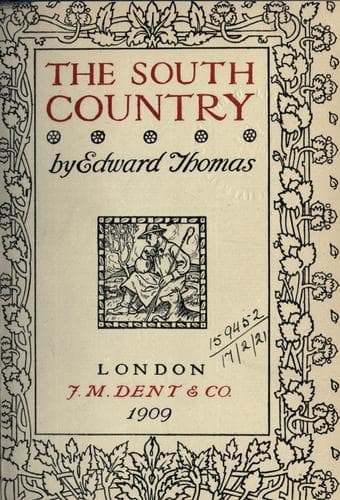
England -- Description and travel; Natural history -- England; Thomas, Edward, 1878-1917 -- Travel -- England
Some of these scenes, whether often repeated or not, come to have a
rich symbolical significance; they return persistently and, as it
were, ceremoniously--on festal days--but meaning I know not what.
For example, I never see the flowers and scarlet-stained foliage of
herb-robert growing out of old stone-heaps by the wayside without a
feeling of satisfaction not explained by a long memory of the contrast
between the plant and the raw flint; so also with the drenched
lilac-bloom leaning out over high walls of unknown gardens; and inland
cliffs, covered with beech, jutting out westward into a bottomless
valley in the mist of winter twilights, in silence and frost. Something
in me belongs to these things, but I hardly think that the mere naming
of them will mean anything except to those--many, perhaps--who have
experienced the same. A great writer so uses the words of every day
that they become a code of his own which the world is bound to learn
and in the end take unto itself. But words are no longer symbols,
and to say “hill” or “beech” is not to call up images of a hill or a
beech-tree, since we have so long been in the habit of using the words
for beautiful and mighty and noble things very much as a book-keeper
uses figures without seeing gold and power. I can, therefore, only
try to suggest what I mean by the significance of the plant in the
stone-heap, the wet lilac, the misty cliff, by comparing it with that
of scenes in books where we recognize some power beyond the particular
and personal. All of Don Quixote’s acts have this significance; so
have the end of Mr. Conrad’s story of _Youth_ and the opening of Mr.
Hudson’s _El Ombu_--the old man sitting on a summer’s day under the
solitary tree to tell the history “of a house that had been.” Malory’s
_Morte d’Arthur_ is full of scenes like this. For ten centuries, from
the battle of Badon to the writing of _Morte d’Arthur_, these stories
were alive on the lips of many kinds of men and women in many lands,
from Connemara to Calabria. Many of these men and women survive only
in the turns which their passionate hearts gave to these ghostly,
everlastingly wandering tales. Artists have worked upon them. Bards
have sung them, and the sound of their harping is entangled in the
words that have reached us to-day. This blending of many bloods is
suggested by the Saracen in the _Morte d’Arthur_ who was descended
from Hector and Alexander and Joshua and Maccabæus; by Taliesin, whose
“original country is the region of the summer stars,” who was with
Noah and Alexander and at the birth of Christ. And thus has the tale
become so full in the ear of humanity, so rich in scenes designed to
serve only an immediate purpose, yet destined by this grace to move
all kinds of men in manifold ways. Such is the chess-playing in _The
Dream of Rhonabwy_; the madness of Tristram when he ran naked in the
wood many days, but was lured by the music of a damsel playing on his
Public-domain text, read in full here on John Shaqi.
Reviews
Reviews
No reviews yet
Be the first to share your thoughts on this work.
Join the Discussion
Join the discussion
Sign in to leave a comment or review.
Sign InorCreate an account