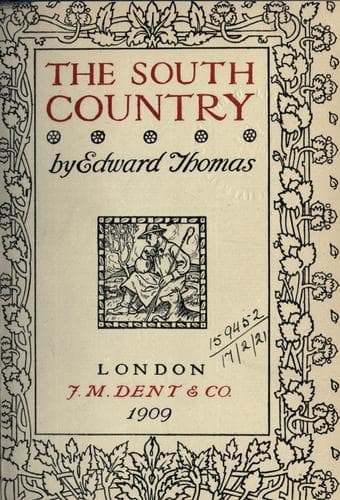
England -- Description and travel; Natural history -- England; Thomas, Edward, 1878-1917 -- Travel -- England
“For God,” says he, “hath made you able to create worlds in your own
mind which are more precious unto Him than those which He created; and
to give and offer up the world unto Him, which is very delightful in
flowing from Him, but made more in returning to Him.”
That power to create worlds in the mind is the imagination, and is
the proof that the creature liveth and is divine. “Things unknown,”
he says, “have a secret influence on the soul,” and “we love we know
not what.” The spirit can fill the whole world and the stars be your
jewels: “You never enjoy the world aright, till the sea itself floweth
in your veins, till you are clothed with the heavens, and crowned with
the stars, and perceive yourself to be the sole heir of the whole
world.” And our inheritance is more than the world, “because men are
in it who are every one sole heirs as well as you.” It is a social
mysticism. “The world,” he says in another place, “does serve you,
not only as it is the place and receptacle of all your joys, but as
it is a great obligation laid upon all mankind, and upon every person
in all ages, to love you as himself; as it also magnifieth all your
companions.” His is the true “public mind,” as he calls it. “There is
not,” he says in another place--“there is not a man in the whole world
that knows God, or himself, but he must honour you. Not only as an
Angel or as a Cherubim, but as one redeemed by the blood of Christ,
beloved by all Angels, Cherubims, and Men, the heir of the world, and
as much greater than the Universe, as he that possesseth the house
is greater than the house. O what a holy and blessed life would men
lead, what joys and treasures would they be to each other, in what a
sphere of excellency would every man move, how sublime and glorious
would their estate be, how full of peace and quiet would the world be,
yea, of joy and honour, order and beauty, did men perceive this of
themselves, and had they this esteem for one another!”
Here, as in other passages, he seems to advance to the position of
Whitman, whom some have blamed for making the word “divine” of no value
because he would apply it to all, whereas to do so is no more than to
lay down that rule of veneration for men--and the other animals--which
has produced and will produce the greatest revolutions.
Public-domain text, read in full here on John Shaqi.
Reviews
Reviews
No reviews yet
Be the first to share your thoughts on this work.
Elsewhere in the archive
Join the Discussion
Join the discussion
Sign in to leave a comment or review.
Sign InorCreate an account