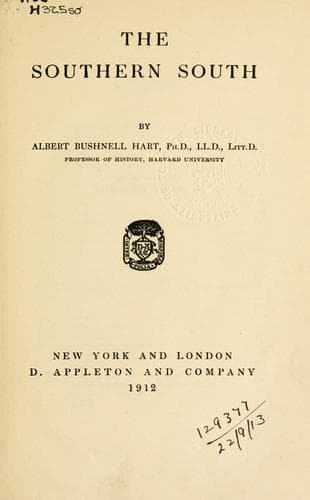
Southern States -- Social conditions; United States -- Race relations
The South has not only its own division of special classes, its own
methods of influence, it has also its own way of looking at the problems
of the universe, and especially that department of the universe south of
Mason and Dixon's line. To discover the temperament of the South is
difficult, for upon the face of things the differences of the two sections
are slight. Aside from little peculiarities of dialect, probably no more
startling than Bostonese English is to the Southerner when he first hears
it, the people whom one meets in Southern trains and hotels appear very
like their Northern kinsfolk. The Memphis drummer in the smoker tells the
same stories that you heard yesterday from his Chicago brother; the
members of the Charleston Club talk about their ancestors just like the
habitués of the Rittenhouse Club in Philadelphia; the President of the
University of Virginia asks for money for the same reasons as the
President of Western Reserve University; Northern and Southern men,
meeting on mutual ground and avoiding the question of the Negro, which
sometimes does not get into their conversation for half an hour together,
find their habits of thought much the same: the usual legal reasoning,
economic discussion, and religious controversy all appeal to the same kind
of minds. Northerners read Lanier with the same understanding with which
Southerners read Longfellow.
Nevertheless there is a subtle difference of temperament hard to catch and
harder to characterize, which may perhaps be illustrated by the difference
between the Northern "Hurrah" and the "Rebel yell"; between "Yankee
Doodle" and "Dixie," each stirring, each lively, yet each upon its
separate key. Upon many questions, and particularly upon all issues
involving the relations of the white and negro races, the Southerner takes
things differently from the Northerner. He looks upon himself from an
emotional standpoint. Thomas Dixon, Jr., characterizes his own section as
"The South, old-fashioned, medieval, provincial, worshipping the dead, and
raising men rather than making money, family-loving, home-building,
tradition-ridden. The South, cruel and cunning when fighting a treacherous
foe, with brief, volcanic bursts of wrath and vengeance. The South,
eloquent, bombastic, romantic, chivalrous, lustful, proud, kind and
hospitable. The South, with her beautiful women and brave men."
Public-domain text, read in full here on John Shaqi.
Reviews
Reviews
No reviews yet
Be the first to share your thoughts on this work.
Join the Discussion
Join the discussion
Sign in to leave a comment or review.
Sign InorCreate an account