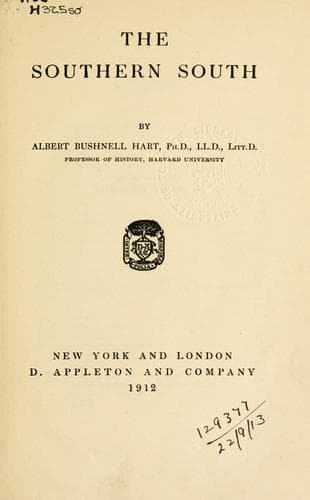
Southern States -- Social conditions; United States -- Race relations
This self-consciousness is doubtless in part a result of external
conditions, such as the isolation of many parts of the South; but still
more is due to an automatic sensitiveness to all phases of the race
question. People in the South often speak of their "two peoples" and "two
civilizations"; and at every turn, in every relation, a part of every
discussion, is the fact that the population of the South is rigidly
divided into two races marked off from each other by an impassable line of
color. The North has race questions, but no race question: the foreign
elements taken together are numerous enough, and their future is uncertain
enough to cause anxiety; but they are as likely to act against each other
as against the group of people of English stock; as likely to harmonize
with native Anglo-Saxon people as to oppose them--they are not a combined
race standing in a cohort, watchful, suspicious, and resentful. The North
has twenty race problems; the South has but one, which for that very
reason is twenty times as serious. In every field of Southern life,
social, political, economic, intellectual, the presence of two races
divides and weakens. The blacks and the Whites in the South are the two
members of a pair of shears, so clumsily put together that they gnash
against each other continually. Though one side be silver, and the other
only bronze, neither can perform its function without the other, but there
is a terrible strain upon the rivet which holds them together.
This state of tension is not due wholly to the Negroes, nor removable by
improving them, as though the straightening only the bronze half of the
shears you could make them cut truly. If no Negroes had ever come over
from Africa, or if they were all to be expatriated to-morrow, there would
still remain a Southern question of great import. One of the mistakes of
the Abolition controversy was to suppose that the South was different from
the North simply because it had slaves; and that the two sections would be
wholly alike if only the white people felt differently toward the Negro.
The Negro does not make all the trouble, cause all the concern, or attract
all the attention of thoughtful men in the South. In every part of that
section, from the most remote cove in the Tennessee mountains to the
stateliest quarter of New Orleans, there is a Caucasian question, or
rather a series of Caucasian questions, arising out of the peculiar
make-up of the white community, though alongside it is always the shadow
of the African.
Public-domain text, read in full here on John Shaqi.
Reviews
Reviews
No reviews yet
Be the first to share your thoughts on this work.
Join the Discussion
Join the discussion
Sign in to leave a comment or review.
Sign InorCreate an account