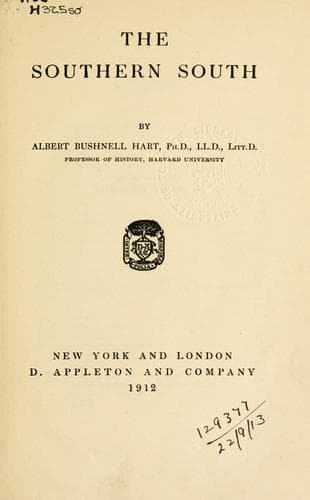
Southern States -- Social conditions; United States -- Race relations
If the thinking people of the South were less willing to share the
discussion with the North, it would still be a Northern concern; for the
Southern race problem, like the labor unions of the manufacturing North,
the distribution of lands in the far West, and the treatment of Mongolians
on the Pacific Coast, is nobody's exclusive property. There must be
freedom for the men of every section to discuss every such question; it is
the opportunity for mutual helpfulness. For instance, how much might be
contributed to an understanding of the decay of the New England hill towns
by a Southern visitor who should visit them and then report upon them from
his point of view. Violent, ignorant, and prejudiced discussion of any
section of the Union by any other section is, of course, destructive of
national harmony; but the days have gone by when it could be thought
unfriendly, hostile, or condemnatory for Northern men to strive to make
themselves familiar with the race questions of the South. "We are everyone
members of another," and the whole body politic suffers from the disease
of any member. The immigrant in the North is the concern of the Southerner
for he is to become part of America. The status of the plantation hand in
Alabama is likewise a Northern problem; as Murphy has recently said: "The
Nation, including the South as well as the North, and the West as well as
the South and the North, has to do with every issue in the South that
touches any national right of the humblest of its citizens. Too long it
has been assumed, both at the North and at the South, that the North is
the Nation. The North is not the Nation. The Nation is the life, the
thought, the conscience, the authority, of all the land."
CHAPTER VII
ATTITUDE TOWARD HISTORY
The history of the United States is a rope of many strands, each of which
was twisted into form before they were united into one cable. Each state
marks the sites of its first landings, puts monuments on its battlefields,
commemorates its liberty days, and teaches its children to remember the
great years of the past. The South has a full share of these memories,
which are both local events and foundation stones of the nation's history.
Jamestown, St. Mary's, Charleston, Fort Moultrie, Yorktown, Mobile, belong
to us all, as much as Providence, Bunker Hill, Saratoga, and San
Francisco.
Public-domain text, read in full here on John Shaqi.
Reviews
Reviews
No reviews yet
Be the first to share your thoughts on this work.
Elsewhere in the archive
Join the Discussion
Join the discussion
Sign in to leave a comment or review.
Sign InorCreate an account