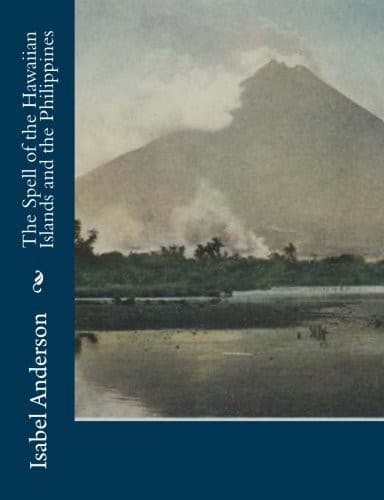
The Spell of the Hawaiian Islands and the PhilippinesAnderson, Isabel
History
The Spell of the Hawaiian Islands and the Philippines
Anderson, Isabel
Hawaii; Philippines
Unfortunately we were unable to see the Ditch Trail, so well described
by Jack London, or visit the famous Iao Valley, of which we had read
such glowing descriptions. The entrance to this "gulch" is by a dark,
wooded gorge that broadens out into an amphitheater surrounded by
precipices as lofty as those of the Yosemite. These cliffs are covered
with masses of trees, shrubs, and graceful, feathery ferns, which are
veiled in turn by the mists from a thousand waterfalls. At the head of
the valley stands the Needle, a natural watch-tower--of rock, but green
with a luxuriant vegetation--to which the defeated army retreated in the
battle of the Wailuku.
East Maui consists entirely of the huge extinct volcano of Haleakala,
"house built by the sun." This, the largest extinct volcano on the
surface of the globe, lifts its enormous crater, twenty miles in
circumference, to the height of ten thousand feet above the sea. Some
titanic eruption blew off the top of the mountain and scooped it out to
the depth of two thousand feet. From the bottom of this vast cavity rise
many cones--the largest a hill of seven hundred feet--and there are two
great gaps in the walls, through which lava flows once made their way
down to the plain. Here and there on the desert that forms the floor of
the crater are scattered clumps of silversword, with long leaves shining
in the sun. This plant grows only at a high altitude. Hunting for it is
like hunting for the edelweiss in Switzerland. Its nearest botanical
relative is found in the Himalaya Mountains. From the highest point of
the rim of Haleakala these plants are said to appear about the size and
brightness of silver dollars.
Glad enough we were to land at Hilo--Hawaiian for "new moon." It takes
its name from the superb crescent of the bay, two miles in length,
perhaps the most beautiful on the shores of the Pacific Ocean. At one
end of the semicircle is Cocoanut Island, crowded with glorious palms
that seem eager for the salt water, stretching their heads far out over
it, as if they would drink it up. As it is on the windward side of the
island, the trade winds bring Hilo a yearly rainfall of 150 inches, and
the result is seen in the luxuriance of the vegetation, which nearly
hides the buildings of the little city in its depths. With the bay in
front, the dense forest belt in the rear, and the towering masses of
Mauna Kea and Mauna Loa in the background, the situation of Hilo is
glorious in its beauty.
[Illustration: SILVERSWORD IN BLOOM, IN THE CRATER OF HALEAKALA.]
On the thirty-mile trail to the crater we passed first between the
brakes of cane plantations, then through a fine tropical forest. Among
the trees we could see many gay and beautiful flowers, curious fruits
and enormous tree ferns, while in the interior were lovely glades and
the little bungalows of the coffee planters. But the island was only
just being developed, so there were numbers of ranches in the first
stages of raw newness.
Public-domain text, read in full here on John Shaqi.
Reviews
Reviews
No reviews yet
Be the first to share your thoughts on this work.
Join the Discussion
Join the discussion
Sign in to leave a comment or review.
Sign InorCreate an account