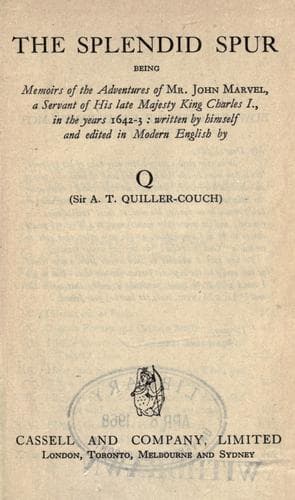
The Splendid Spur: Being Memoirs of the Adventures of Mr. John Marvel, a Servant of His Late Majesty King Charles I, in the Years 1642-3Quiller-Couch, Arthur
History
The Splendid Spur: Being Memoirs of the Adventures of Mr. John Marvel, a Servant of His Late Majesty King Charles I, in the Years 1642-3
Quiller-Couch, Arthur
Great Britain -- History -- Charles I, 1625-1649 -- Fiction
’Tis like a bad dream to me, and I will not dwell on it. That night
we pass’d at Chippenham—a small market town—and on the morrow went
tramping again through worse weather, but always amid the same sights
and sounds. There were moments when I thought to go mad, wrenching at my
cords till my wrists bled, yet with no hope to escape. But in time, by
good luck, my wits grew deaden’d to it all, and I march’d on with the
rest to a kind of lugubrious singsong that my brain supplied. For hours
I went thus, counting my steps, missing my reckoning, and beginning
again.
Daylight was failing when the towers of Bristol grew clear out of the
leaden mist in front; and by five o’clock we halted outside the walls
and beside the ditch of the castle, waiting for the drawbridge to be let
down. Already a great crowd had gather’d about us, of those who had come
out to learn news of the defeat, which, the day before some fugitives
had carried to Bristol. To their questions, as to all else, I listen’d
like a man in a trance: and recall this only—that first I was shivering
out in the rain and soon after was standing beside Delia, under guard
of a dozen soldiers, and shaking with cold, beneath a gateway that led
between the two wards of the castle. And there, for an hour at least, we
kick’d our heels, until from the inner ward Captain Stubbs came striding
and commanded us to follow.
Across the court we went in the rain, through a vaulted passage, and
passing a screen of carved oak found ourselves suddenly in a great hall,
near forty yards long (as I reckon it), and rafter’d with oak. At the
far end, around a great marble table, were some ten or more gentlemen
seated, who all with one accord turn’d their eyes upon us, as the
captain brought us forward.
The table before them was litter’d with maps, warrants, and papers; and
some of the gentlemen had pens in their hands. But the one on whom my
eyes fastened was a tall, fair soldier that sat in the centre, and held
his Majesty’s letter, open, in his hand: who rose and bow’d to me as I
came near.
“Sir,” he said, “the fortune of war having given you into our hands, you
will not refuse, I hope, to answer our questions.”
“Sir, I have nought to tell,” answer’d I, bowing in return.
With a delicate white hand he wav’d my words aside. He had a handsome,
irresolute mouth, and was, I could tell, of very different degree from
the merchants and lawyers beside him.
“You act under orders from the—the—”
“Anti-Christ,” put in a snappish little fellow on his right.
“I do nothing of the sort,” said I.
“Well, then, sir, from King Charles.”
“I do not.”
“Tush!” exclaim’d the snappish man, and then straightening himself
up—“That boy with you—that fellow disguis’d as a countryman—look at
his boots!—he’s a Papist spy!”
“There, sir, you are wrong!”
“I saw him—I’ll be sworn to his face—I saw him, a year back, at Douai,
helping at the mass! I never forget faces.”
“Why, what nonsense!” cried I, and burst out laughing.
Public-domain text, read in full here on John Shaqi.
Reviews
Reviews
No reviews yet
Be the first to share your thoughts on this work.
Elsewhere in the archive
Join the Discussion
Join the discussion
Sign in to leave a comment or review.
Sign InorCreate an account